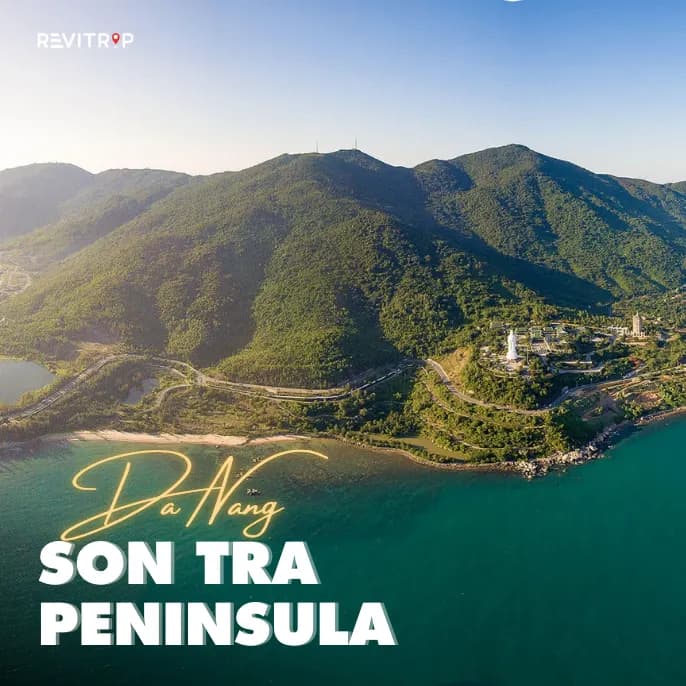
Son Tra Peninsula: Where the Mountain Meets the Sea and Sky
Son Tra peninsula doesn’t ask for your attention loudly. It waits above Da Nang in its own weather, with jungle folds, sea light, and roads that keep curling toward silence. You leave the city behind by only a short drive, and yet the mood changes. The air feels lighter. The horizon opens. The day begins to hit different.
Son Tra sits about 10 kilometers northeast of central Da Nang. It stretches into the East Sea as the last reach of the northern Truong Son range, with a protected landscape of forest, coastline, streams, and mountain roads. Its highest point rises to roughly 696 meters, and the peninsula covers about 4,390 hectares.
That is the practical description. The emotional one is simpler. Son Tra feels like the part of Da Nang belongs to wind, leaves, and distance.
A peninsula made for soft mornings
The best time to meet Son Tra is in the early morning. Not because a guidebook says so, but because morning flatters this place. The sea is pale and glassy. The curves of the road still hold the last coolness of night. The city below looks clean and half-awake, as if someone has not finished drawing it yet.
You do not rush on Son Tra. Even when people arrive by motorbike, they tend to slow down after the first few bends. There is too much to look at. A shoulder of mountain dropping into water. Fishing boats stitched across the bay. Mist caught in the trees. The strange, lovely feeling that Da Nang is close enough to see, but far enough to stop mattering for a while.
That is part of Son Tra’s charm. It gives you height without harshness. It gives you views without making them feel staged.
From the higher roads, the sea opens wide and the coastline below begins to be part of the same landscape.
Son Tra may be the quieter edge of the city, but the coastline below is part of the same story.
The forest is the real heart
Most visitors come for the viewpoints. Son Tra knows how to make an entrance. But the deeper beauty of the peninsula lives in the forest itself.
This is one of Da Nang’s most important green spaces, often described as the city’s “green lung.” The peninsula holds rich biodiversity, with more than 1,000 plant species and 370 animal species recorded in the reserve. It is also home to more than 1,300 red-shanked douc langurs, one of the rarest and most visually striking primates in the region.
Son Tra is a living habitat. The trees are doing real work. The silence is inhabited. Even the beauty feels more fragile when you know that something rare is still breathing inside it.
If you are lucky, you may catch a quiet glimpse of a red-shanked douc in the branches, balanced so lightly it almost looks imagined. That brief moment can change the whole rhythm of a trip: The peninsula is no longer a backdrop. It becomes a place with its own life, one that goes on whether tourists arrive or not.

Linh Ung – Son Tra’s spiritual side
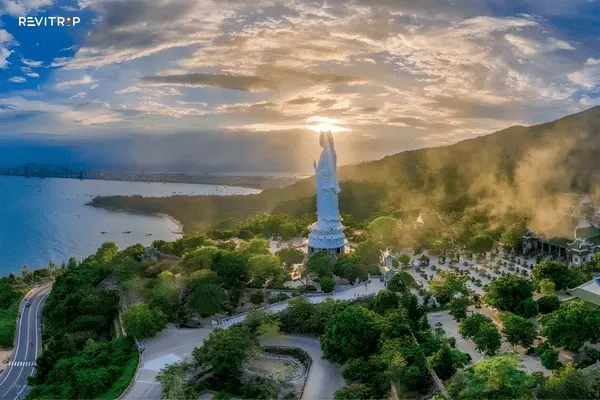
Then there is Linh Ung Pagoda, the best-known stop on the peninsula and the one that changes the atmosphere most clearly. You can feel it as you arrive. The wind stays wild, the sea stays open, but the space grows still.
Linh Ung Pagoda stands in the Bai But area of Son Tra, about 10 kilometers from Da Nang’s center. Construction began in 2004 and the complex was inaugurated in 2010.
People come here for many reasons. Some come for the view. Some come for the giant Lady Buddha rising above the slope. Some come because travel always makes room for a little quiet, even in people who do not think of themselves as spiritual.
Whatever brings you there, Linh Ung has a way of softening the day. The courtyards feel open but never empty. The sea below seems less restless from this height. Incense drifts into the wind and disappears. The white statue looks out toward the water with a calm that feels larger than religion and older than tourism.
If Son Tra begins as a landscape, Linh Ung makes it personal. It becomes a place people return to not only for photographs, but for mood. For steadiness. For that brief sensation that the world has lowered its voice.
Ban Co Peak – sky and distance
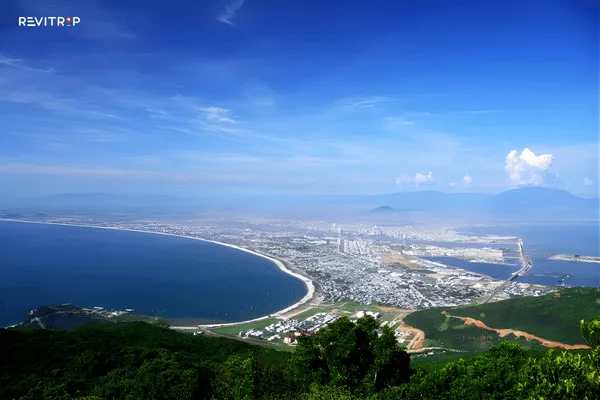
Higher up, Son Tra becomes rougher, wider, and more exposed. The road climbs, the city thins into geometry, and the sea starts looking endless. Then you reach Ban Co Peak, where Da Nang opens below you in one sweeping curve.
Ban Co Peak is at around 700 meters above sea level, with broad views across the city, Han River, bridges, and coastline.
People often describe this as one of the best viewpoints in Da Nang, and that is true. But the feeling of the place is better than the photograph. Wind moves harder up here. The light changes faster. You do not just see the city. You see how small it is against the water, and how gently Son Tra holds it from the edge.
This is where the peninsula feels most romantic to me. Not in a cinematic way, but in a quieter way. In the way distance can make things seem dearer. You look down at Da Nang and feel both close to it and outside it. The city becomes something you can admire without needing to join again.
Son Tra belongs to every kind of weather
Dry season is usually the easiest time to explore, especially from around March to September, when roads are clearer and visibility is better. During the wetter months, rain, fog, and slippery roads can make the peninsula more difficult to navigate. Visitors are currently allowed on designated routes during set hours, generally from 7:30 a.m. to 6:30 p.m. from March through September, and from 7:30 a.m. to 5:30 p.m. from October through February.
Still, Son Tra is not only a dry-season place. It changes beautifully with weather. On bright days, it feels open and coastal, almost celebratory. Under cloud, it becomes moodier and more private. The mountain darkens. The sea turns steel-blue. The road seems to lead somewhere older and less named.
That is why Son Tra stays in people’s minds. It does not offer only one version of beauty. It keeps shifting, and each version has its own pull.
Son Tra stays with people
Son Tra is hard to forget because it leaves behind a feeling.
Maybe it is the way forest and sea meet so closely. Maybe it is the sight of Da Nang from above, suddenly softened into light and shape. Maybe it is the quiet authority of Linh Ung, or the possibility of rare wildlife hidden just beyond the road. Maybe it is simply the fact that Son Tra still feels slightly untamed, even while sitting so near the city.
Whatever the reason, the peninsula lingers.
You remember the curve of the road more than the map. You remember the wind. You remember how the blue seemed to go on forever. And if you visited in the right hour, when the morning was thin and silver or the afternoon had begun to melt into gold, you probably remember Son Tra as more than a place to stop in Da Nang.
You remember it as the moment Da Nang turned quieter, wilder, and unexpectedly tender.
FAQ
Yes. Official tourism information lists coral snorkeling and diving tours in the Bai Nam area, where visitors can see coral and marine life just off the peninsula.
Son Tra Nature Reserve is the protected forested heart of the peninsula, known for primary forest, streams, beaches, and rare wildlife. Official tourism information notes 289 recorded plant species and nearly 300 red-shanked douc langurs in the area.
From central Da Nang, head about 10 kilometers northeast toward Son Tra. It is commonly described as around 20 minutes from the city center, and Linh Ung Pagoda is one of the easiest first stops to put on your map.