Mua Cave Ninh Binh: The Climb Worth Every Step
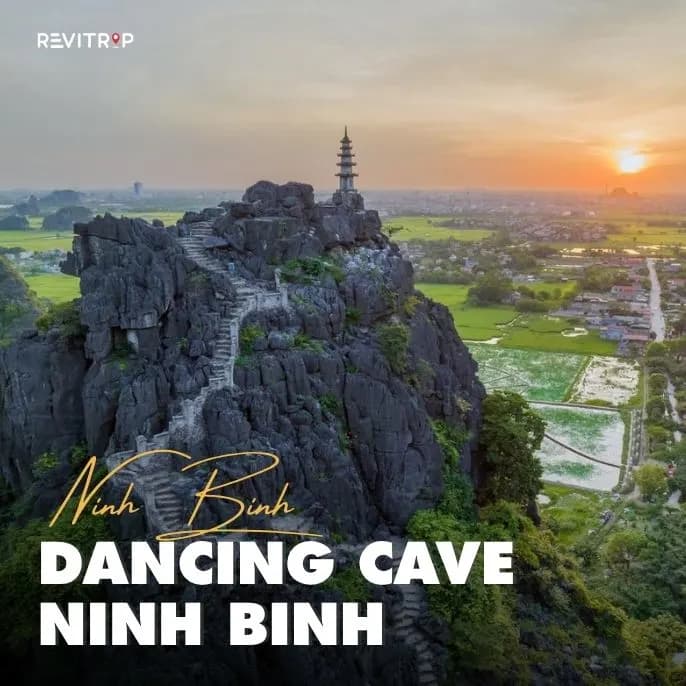
Every traveler visiting Ninh Binh ends up at Tam Coc or Trang An, drifting through caves by boat and looking up at the limestone karsts from the water. Mua Cave offers the opposite perspective entirely. From its summit, you look down across the entire valley: the Ngo Dong River winding through golden rice fields, the karst formations stretching to the horizon, and the boats on the Tam Coc river reduced to tiny dots far below. It is the view that finally makes sense of the whole landscape. And the 500-step climb to reach it is, genuinely, worth every step.
Summary
| Detail | Information |
|---|---|
| Local Name | Hang Mua (Dancing Cave) |
| Location | Khe Ha Village, Ninh Xuan Commune, Hoa Lu District |
| Distance from Tam Coc | 5 km |
| Distance from Ninh Binh City | 6 km |
| Entrance Fee | 100,000 VND per adult |
| Opening Hours | 06:00 – 19:00 daily |
| Number of Steps | Approximately 486 – 500 stone steps |
| Climb Duration | 20 to 45 minutes depending on fitness |
| Total Visit Time | 60 to 90 minutes recommended |
The History Behind the Name
Mua Cave’s name translates directly as “Dancing Cave,” and the story behind that name is worth knowing before you climb. According to local history, King Tran Thai Tong, the first emperor of the Tran Dynasty, built the Thai Vi Temple upon his return to Hoa Lu. During his visits to Hang Mua, he would watch traditional music and dance performances with his concubines. This earned the cave its name, Hang Mua, meaning Dancing Cave in Vietnamese.
The mountain’s heritage, however, extends further back than royal entertainment. The natural vantage point for surveying the surrounding countryside dates back to as early as 1226, when it became a strategic asset for tracking and eventually repelling the Mongol invaders of the Yuan Dynasty. Furthermore, during the various resistance wars against the French and American invasions, Hang Mua also served as a triage hospital for the treatment and shelter of wounded soldiers.
The mountain itself, Ngoa Long (Reclining Dragon), reflects traditional Vietnamese beliefs that dragons protect sacred landscapes. The stone dragon statue at the summit symbolizes power, harmony with nature, and protection over the fertile Tam Coc valley below. Together, these layers of history and symbolism give the climb a depth that the view alone does not fully convey. For broader context on the heritage landscape surrounding Mua Cave, our Hoa Lu Ancient Capital guide covers the dynastic history of the region in detail.

What You Will Find at Mua Cave
The Lotus Lake and Gardens
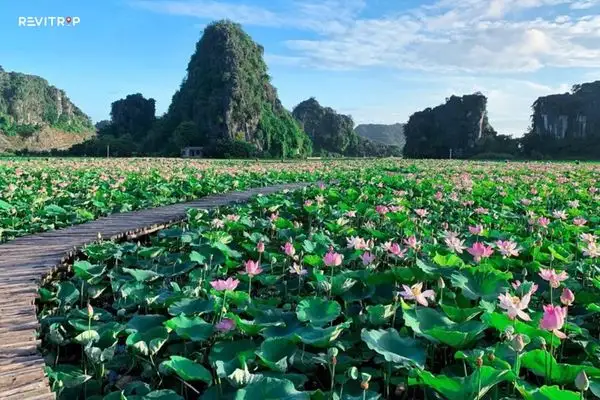
Near the entrance, visitors can explore Tiger Cave and landscaped gardens without climbing the mountain. This area suits families or travelers who prefer light walking instead of the full hike. Inside Tiger Cave, a tiny cave at the mountain base, you will find stalactites and stalagmites. At the base of the mountain lies a lotus lake surrounded by rice fields. From May to June, pink lotus flowers bloom across the water, creating one of the most scenic and relaxing areas of the site. Wooden walkways and bridges make it easy to explore.
The lotus lake is genuinely beautiful and worth spending time at before the climb. Many visitors rush past it on the way to the stairs and then wish they had stopped properly on the way back down when their legs are tired.
The 500-Step Staircase
The staircase itself is an impressive feat, often likened to a mini Great Wall of Vietnam. Along the path, look for intricately sculpted stone statues depicting mythical creatures like dragons and phoenixes, potent symbols in Vietnamese folklore. Various images of animals, such as the Nghe (Vietnamese guardian lions) statues plus reliefs depicting the spiritual and architectural culture of the Vietnamese people, can be found on either side of the stairway. These figures, placed on stone pillars, create a sense of companionship and protection during the arduous climb.
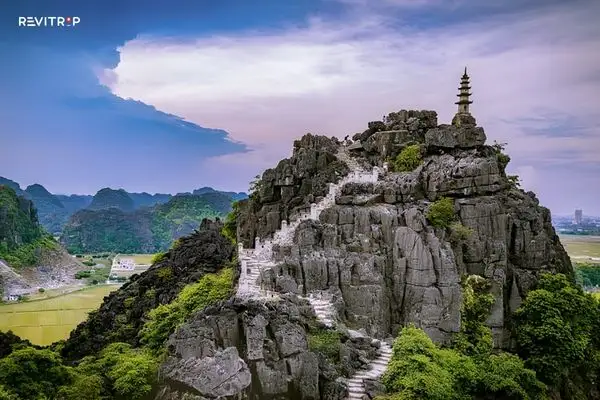
The steps are steep and uneven in places. However, handrails line most of the route and rest points appear at intervals. Two-thirds of the way up, the path reaches a fork. A small snack and drinks stand sits at this junction. Take a break here if you need it. Cold water and coconuts are available.
The Two Viewpoints
At the fork, the path splits into two distinct summits. Each delivers a different experience.
Dragon Peak (Left Fork): The dragon viewpoint is the higher of the two and the most impressive, in our opinion. From this side, you can look down at the Tam Coc boats rowing along the Ngo Dong River. At the top of yet another flight of stairs, a long snaking dragon overlooks and protects the large white marble statue of Guanyin (Quan Am in Vietnam) facing the wilder south west tumble of mountains and lakes. The dragon is known as the tallest in Ninh Binh. This is the most photographed spot on the mountain and consequently the busier of the two summits. Go here first, before tour groups arrive.
Pagoda Peak (Right Fork): A shorter climb to the right offers a more secluded setting to envision the ancient valley and lotus ponds nearby. Turning right will take you to the pagoda area and the small Buddhist tower that overlooks the farms and villages hundreds of meters below. The Pagoda Peak draws fewer visitors and suits travelers who want the panoramic view without the crowd. It is the better option for unhurried photography and quiet reflection.

My Experience at Mua Cave
I arrived at 06:15 on a clear morning in late March, just as the entrance gate opened. The lower garden was empty. The lotus lake reflected the early light perfectly. The climb itself was genuinely demanding for the first 200 steps. After that, the rhythm settled and the view improved with every 20 steps, which kept the motivation going. At the Dragon Peak, I arrived before any tour groups and had the summit almost entirely to myself for around 20 minutes. The view of the Tam Coc valley below, with the river catching the morning light and the karsts casting long shadows across the rice fields, is the single best elevated landscape view I have experienced in northern Vietnam. Notably, it surpasses even the Bai Tho Mountain view in Ha Long for sheer scale and visual completeness.
Best Time to Visit Mua Cave
By Season
The ripe rice season from late May to early July is arguably the most picturesque time. The rice paddies transform into a stunning golden carpet, creating breathtaking landscapes. The weather is generally pleasant, making it a highly recommended period. Additionally, in April, the rice fields are lush and green, while by late May to June, they turn a rich golden yellow during harvest season. If you are hoping to see the lotus ponds in bloom, plan your visit for July.
The dry season from November to April offers cooler, more comfortable climbing conditions and generally clearer skies. However, the rice fields may appear green or fallow rather than golden depending on the specific month.
By Time of Day
The best time to visit is early in the morning around 06:00 before the crowds arrive, or in the late afternoon for spectacular sunset views. Tour groups from Hanoi typically arrive from midday onward. Consequently, the window between 06:00 and 09:00 offers the clearest summit, the most comfortable temperatures, and the best photography light. Sunset visits work well for travelers already staying in Ninh Binh who can time the climb independently.
How to Get to Mua Cave
Mua Cave sits 5 km from Tam Coc and 6 km from Ninh Binh City. From Tam Coc, the most enjoyable option is cycling. The route passes through rice paddies and small villages, and the 20 to 30-minute cycle is scenic enough to justify the effort on its own. Motorbike rental from Tam Coc takes around 10 minutes. Grab taxis from Ninh Binh City take 5 to 10 minutes.
From Hanoi, travelers can reach Mua Cave by limousine van (2 to 2.5 hours, approximately $8 USD), train to Ninh Binh Station (2 hours), or private car. After arriving in Ninh Binh, a short 15-minute taxi or Grab ride takes you directly to the Hang Mua entrance.
Parking: Use only the official parking lot inside the entrance gate. Many locals will try to stop you and offer parking on the way to Mua Cave. Do not stop. You will end up paying more and walking a long distance. Continue ahead until you reach the end of the road, where you will find the official parking at the entrance gate. Parking costs 5,000 VND for bicycles and 10,000 VND for motorbikes.
Practical Tips for the Climb
Wear proper footwear. Sports shoes with grip are essential. Sandals are not appropriate for the upper sections of the staircase, where steps are uneven and the surface becomes rocky near the summit.
Start at Dragon Peak. Go left at the fork first. Tour groups tend to arrive and fill Dragon Peak from midday. Reaching it early gives you the best photographs without waiting in line at the summit. Move to the quieter Pagoda Peak afterward.
Bring water. The climb is physical and the sun is intense from mid-morning onward. Drinks are available at the fork stall, but carrying your own water from the entrance is smarter and cheaper.
Pace yourself on the lower steps. The first 200 steps are the steepest. Many visitors burn out here by climbing too fast. A slower, steady pace with short stops every 50 steps makes the upper section significantly more manageable.
Allow 90 minutes minimum. Most itineraries allocate 60 minutes for Mua Cave. That is enough to climb and descend, but not enough to spend proper time at both summits and enjoy the lotus lake. Plan for 90 minutes if your schedule allows.
Check conditions before visiting in rainy season. Visiting during the off-season is a great way to avoid the crowds. However, steps become genuinely slippery after rain, and visibility at the summit drops significantly during overcast or foggy conditions.
How to Combine Mua Cave with Other Ninh Binh Attractions
Mua Cave sits naturally between several of Ninh Binh’s main attractions and fits logically into most itinerary formats. The most common combination is Mua Cave plus Tam Coc: complete the climb in the morning, then take a Tam Coc boat tour in the afternoon. Both sites are within 5 km of each other. Our Ninh Binh itinerary guide covers exactly how to structure this combination across one, two, and three-day visits.
Alternatively, pair Mua Cave with Trang An for a full day that covers both the elevated land view and the river cave experience. Trang An sits approximately 4 km from Mua Cave. A morning climb at Mua Cave followed by an afternoon Trang An boat tour gives you two completely different perspectives on the same UNESCO-protected karst landscape in a single day.
For food after the climb, Ninh Binh’s local restaurant scene covers the best options near Tam Coc and Ninh Binh City. The com chay (crispy burnt rice) and thit de (mountain goat) dishes are the obvious recovery meal choices after a morning on the steps.
FAQ
Most climbers reach the first summit in 20 to 45 minutes depending on fitness level and how many stops they make. Add another 15 to 20 minutes to visit the second viewpoint and 20 minutes to descend. Budget 90 minutes for the full experience including time at the lotus lake.
The climb is moderately demanding. It suits most adults with reasonable fitness. The steep lower section requires effort, but the upper section becomes more manageable as the gradient eases slightly. The climb is not appropriate for guests with significant mobility concerns, heart conditions, or anyone who struggles with heights, as the upper ridgeline is exposed.
The entrance fee is 100,000 VND per adult. Children under 1 meter in height are typically admitted free. The ticket covers the full complex including the lotus lake, Tiger Cave, the gardens, and both summit viewpoints. Mua Cave is open daily from 06:00 to 19:00.