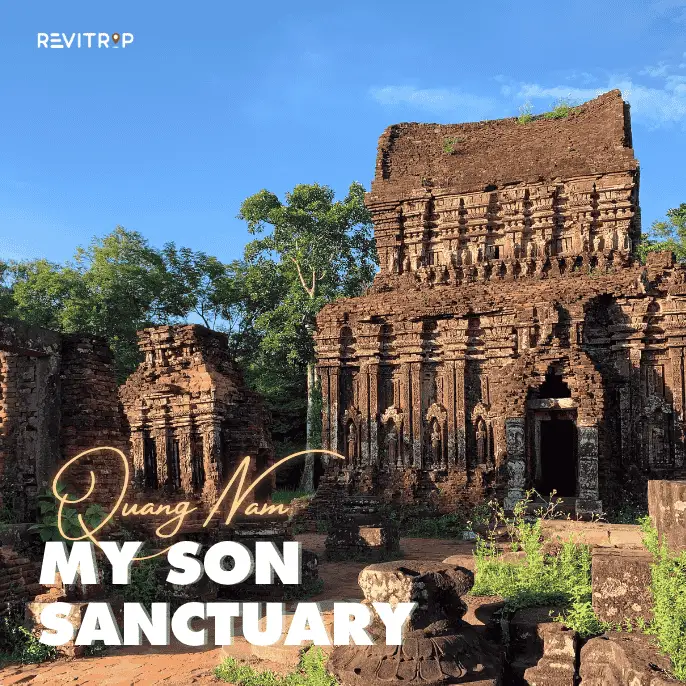
My Son is the place that asks for an early alarm. The valley holds on to the morning a little longer than the coast, and the old brick towers look best before the heat settles over everything. Hidden in a ring of hills in Quang Nam, this was once one of the most important religious centers of the Champa Kingdom, and it still carries that inward, hushed feeling now. The sanctuary dates from the 4th to the 13th centuries and has been on the UNESCO World Heritage List since 1999.
From Hoi An, My Son is a clean half-day escape. From Da Nang, it asks for a slightly earlier start, but it still fits comfortably into one morning if you do not crowd the rest of the day. What matters most is not how much time you throw at it, but when you arrive and how much space you leave for the place to speak in its own quiet way.
The valley before the crowds
My Son opens daily from 6:00 in the morning, with ticket sales running until 5:30 PM and visiting hours until 6:00 PM. On paper, that gives you a long day. In practice, the site is at its loveliest early on, when the air is cooler and the towers still rise out of soft light rather than hard sun. The drier stretch from February to August is usually the easier season for visiting, and the months from February to April tend to feel the most comfortable.
That early hour changes the mood of the whole visit. The paths are easier, the valley feels more spacious, and the old red brick does not look bleached flat. By late morning, especially in warmer months, the heat can make the walk feel heavier than it needs to. If you want My Son to feel atmospheric rather than merely efficient, this is one place where timing does a lot of the work for you.
The road from Hoi An and Da Nang
The sanctuary sits about 45 kilometers west of Hoi An and 68 kilometers from Da Nang, tucked into a basin surrounded by mountains and connected to the Thu Bon river system. From Hoi An, the drive is easy enough that many travelers leave after dawn and are back in town around lunch. From Da Nang, it is still very manageable, but it feels better when My Son is the first thing in the day rather than something squeezed in after breakfast and traffic.
If you are staying in Hoi An, the gentlest version is to leave early, spend the cool part of the morning at the site, and return before the town fully leans into lunch and afternoon visitors. If you are based in Da Nang, leaving around 6:00 to 7:00 usually keeps the day comfortable. Shared tours commonly start at 5:30 AM or 8:00 AM from Hoi An, while departures that include Da Nang often begin around 7:00 AM.
Tickets and the shape of the visit
For international visitors, the official ticket price is 150,000 VND, which is roughly US$5.70 at recent exchange rates. Vietnamese visitors pay 100,000 VND, and the online system also lists a 30,000 VND service ticket. Tickets can be bought in advance through the official online portal, which is useful if you would rather not sort payment at the gate in the early morning.
Most travelers do not need a full day here. The site usually sits well in about two to three hours once you are inside, enough time to walk the main temple groups, pause where the valley opens up, and catch one of the Cham cultural performances if the timing lines up. The current schedule includes performance slots through the morning and later afternoon, with stage times around 9:00, 9:45, 10:30, 11:15, 2:00, 2:45, and 4:00 depending on the area. That is why My Son often lands so neatly as a half-day trip rather than an all-day commitment.
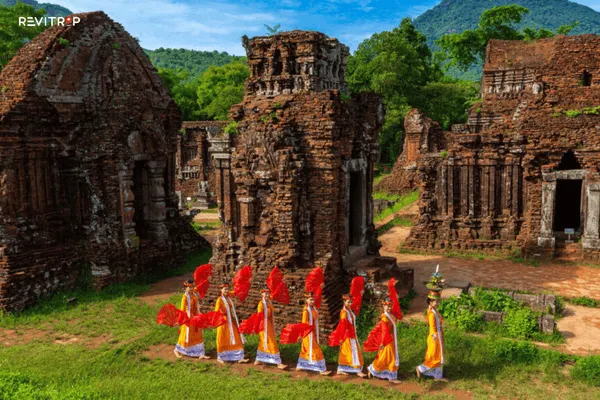
There is one small practical detail worth knowing before you click through checkout: the official portal accepts QR bank payment and international cards including Visa, MasterCard, JCB, and UnionPay, but online tickets are not currently set up for easy cancellation or changes after purchase. It is a small thing, but useful if your schedule in Central Vietnam is still shifting.
Moving through the ruins well
My Son is not physically difficult, but it does feel better with decent shoes, water, and clothes that let you move comfortably in heat. The sanctuary is both an archaeological site and a sacred cultural space, so modest dress is expected inside the tower areas. Visitors are also asked not to touch or climb on the old structures, and photography is allowed as long as flash is avoided around sensitive areas and objects.
This matters more here than in some other heritage stops. My Son is beautiful, but not polished. Part of its force comes from weathering, broken edges, and the long life of the brick itself. You feel the age of the place in fragments, not just in finished silhouettes. Walking through it slowly, with a guide or even just a little context in mind, gives the site more depth than a quick loop built only around photos. UNESCO describes it as exceptional evidence of an Asian civilization that no longer exists in living form, which is part of why the ruins feel so charged even in silence.
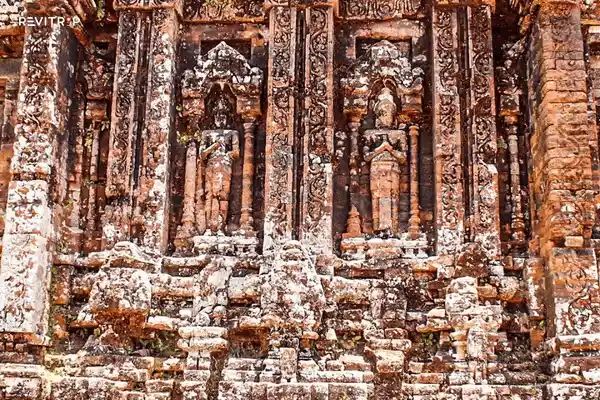
A guided morning or a quiet car ride
For first-time visitors, a guided half-day tour is often the easiest shape for the trip. Not because My Son is hard to reach, but because the place opens up more when someone explains what you are looking at – the Champa kingdom, the Shaiva worship, the valley setting, the tower groups, the carvings, the damage, the survival. Many morning tours from Hoi An also fold in a short Thu Bon river boat segment on the way back, which softens the return nicely after the ruins.
Going independently still works well if you prefer your own pace. A private car from Hoi An or Da Nang lets you arrive early, linger where you want, and leave before the heavier heat. That version tends to suit travelers who care less about a set itinerary and more about having the valley while it still feels spacious. The only thing I would avoid is arriving too late and trying to force My Son into the hottest, busiest part of the day.
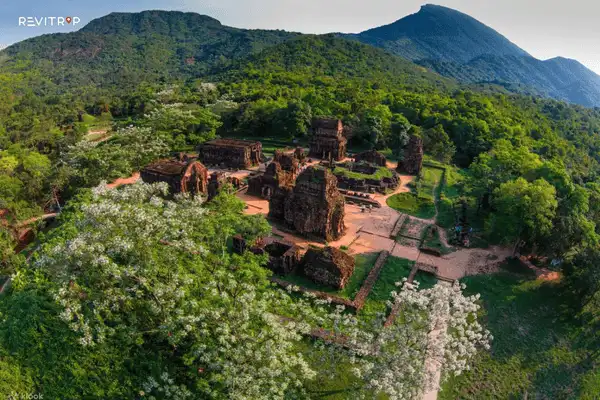
The kind of half day that stays with you
My Son does not need to be overplanned. If you are in Hoi An, it slips naturally into one early morning and leaves the rest of the day untouched. If you are in Da Nang, it works best as the anchor of the morning, with lunch after and nothing rushed around it. Either way, this is not a site that asks for speed. It asks for a little quiet, a little light, and enough time to let the valley gather around the towers the way it still has for centuries.
FAQ
Most travelers need about two to three hours at My Son Sanctuary. That is usually enough time to walk through the main temple groups, take photos, and catch a cultural performance if the timing works.
My Son Sanctuary is famous for its ancient Cham temple towers and its role as one of the most important religious centers of the Champa Kingdom. It is also known for its quiet valley setting and its status as a UNESCO World Heritage Site.
My Son Sanctuary dates from the 4th to the 13th centuries. That means the site is well over a thousand years old, with some of its earliest structures tracing back around 1,600 years.