Ha Long Bay draws visitors for the karst landscape. Most leave talking about the food.
The Gulf of Tonkin produces some of northern Vietnam’s finest seafood, and Ha Long’s cuisine reflects that completely. Squid, mantis shrimp, clams, sea snails, and oysters dominate every menu. A handful of ingredients here exist nowhere else in the country. That combination shapes a food identity that stands apart from Hanoi, from Hoi An, from everywhere else on the Vietnam trail. Ha Long food is not refined or showy. It is coastal, direct, and built on whatever came off the boats that morning.
This guide covers 5 Ha Long dishes worth seeking out: what each one tastes like, where to find it, and which ones to prioritize if your time is short. If you are planning a Ha Long Bay cruise tour and wondering whether to eat on the boat or on land, this guide will help you decide.
Cha Muc (Ha Long Squid Cake): The One Dish That Defines the City
No list of Ha Long food starts anywhere else. Cha muc is the dish that put Ha Long on Vietnam’s culinary map, and it earned that position honestly.
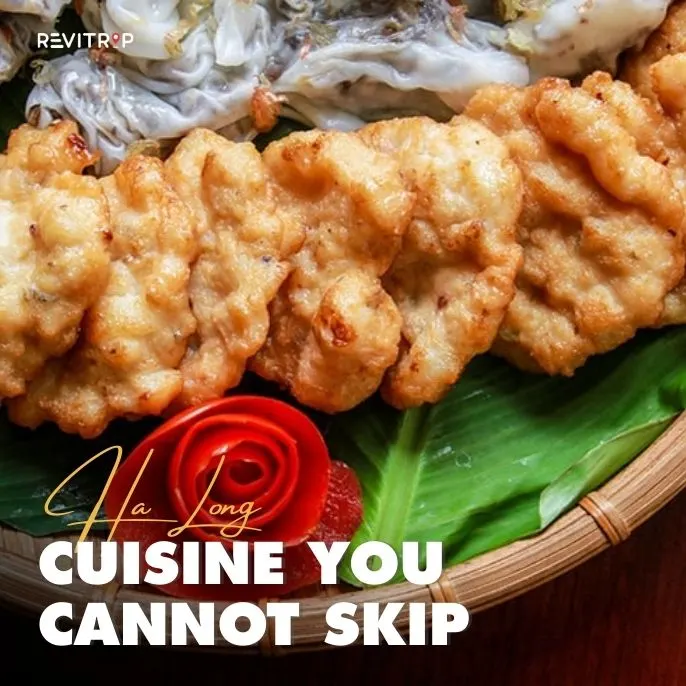
Fresh squid from Ha Long Bay is cleaned, minced, and ground by hand until it forms a dense, springy paste. The squid must come specifically from Ha Long Bay. The clean, cold Gulf waters give it a natural sweetness that squid from elsewhere simply cannot replicate. The paste is seasoned with fish sauce, pepper, dill, and a small amount of pork fat. It is shaped into round patties and deep-fried until golden brown outside and soft inside.
The texture is the thing. Machine-ground squid produces a rubbery, uniform paste. Hand-grinding leaves a slight irregularity, a bounce and chew, that makes cha muc genuinely different from any other squid preparation in Vietnam. Cha muc has ranked among Asia’s top-ten most delicious dishes, and the Quang Ninh provincial government has protected it as an official regional specialty.
Serve it with banh cuon (steamed rice rolls) or sticky rice and a sweet-sour fish sauce dip. That combination is the standard Ha Long breakfast, and it is worth getting up early for.
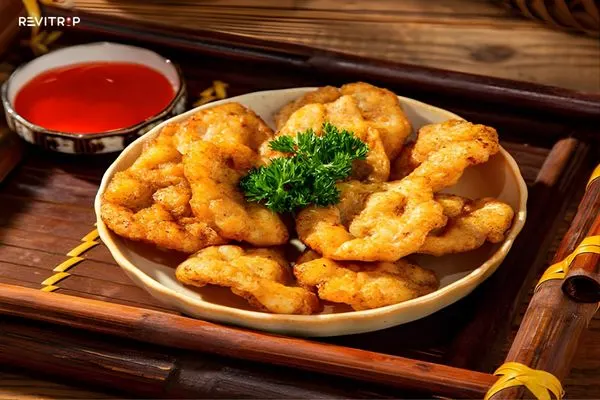
Where to eat it: Banh cuon cha muc Goc Bang, Nha Hat Alley, Bach Dang Ward (around 40,000 VND). Banh cuon cha muc Ba Yen, 36 Doan Thi Diem, Bach Dang Ward (around 35,000 VND). Both are local spots with no English menus and queues that confirm the quality.
Honest take: This is the single non-negotiable Ha Long food experience. If you eat nothing else in the city, eat cha muc with banh cuon at a local breakfast spot. Nothing on the cruise boat comes close.
Bun Be Be (Mantis Shrimp Noodle Soup): The Morning Bowl Nobody Tells You About
Bun be be is Ha Long’s answer to pho, and it is better suited to this city than pho ever could be.
Be be is mantis shrimp, a flat-bodied crustacean with sweet, firm meat and a concentrated briny flavor. The broth is built from pork bones and crab shells, then lifted with tomatoes and a touch of tamarind for a light, gently sour base. A full bowl arrives with vermicelli noodles, two or three whole mantis shrimp, pork ribs, and fried tofu. Green onion and crispy fried dough sticks finish the bowl on the side.
The balance of the broth is what stays with you. It is not heavy, not aggressively sour, not too rich. It is the kind of bowl that makes sense at 7:00 AM with the bay visible through the restaurant window.
Prices run 45,000 to 80,000 VND depending on toppings. Find it at local breakfast stalls in the Hong Hai neighborhood or around the Gieng Don Street Food Market. Local vendors set up from 6:00 AM.
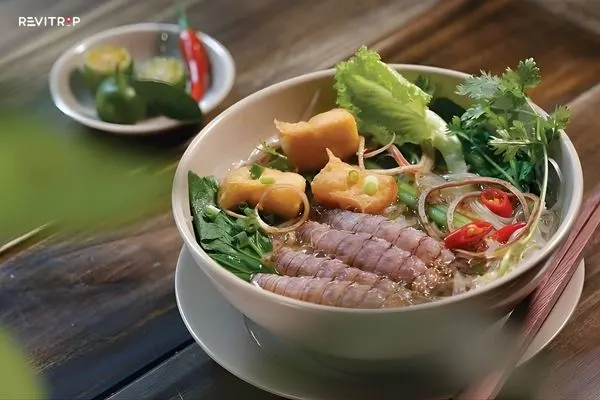
Honest take: Most visitors never try this dish because it does not appear on tourist menus. That is exactly why you should find it. Ask locals to point you toward the nearest bun be be stall. The one with the longest queue is always the right choice.
Ngan (Ha Long Clam): The Bivalve You Have Not Had Before
Ngan is a bivalve mollusk found specifically in the mangrove estuaries around Ha Long Bay and the Quang Ninh coastline. It is larger than a standard clam, with a ridged white shell and a sweeter, meatier interior.
Ha Long cooks prepare ngan multiple ways. Steamed ngan with ginger and rice wine is the simplest way to taste the natural flavor. Grilled ngan with scallion oil is the version you see most at street stalls. Ngan porridge is a slower, more complex take. The most unusual preparation is ngan wine: clam blood mixed with Vietnamese rice wine into a red-colored drink that locals believe strengthens the body. Try it if offered. It tastes less alarming than it sounds.
A plate of steamed ngan runs 80,000 to 150,000 VND at local seafood restaurants in Bai Chay.
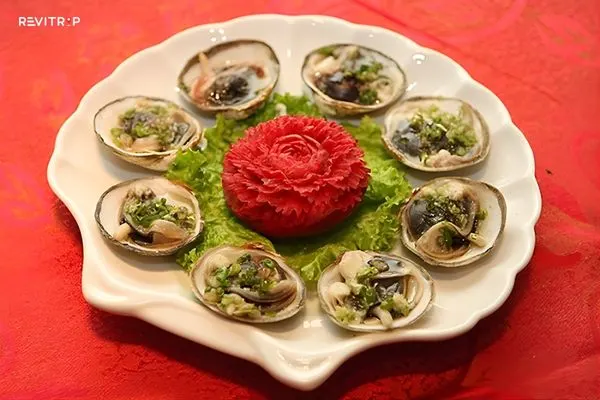
Honest take: Ngan is uniquely Ha Long. You will not find this specific bivalve at the same quality anywhere outside Quang Ninh. If you are already exploring Ha Long food, this should be on the list alongside cha muc.
Banh Gat Gu (Nodding Cake): The Street Snack with Character
Banh gat gu translates as “nodding cake,” named for the way the soft, flexible rice rolls bend when lifted with chopsticks. The name is endearing and accurate.
The cake originates from Tien Yen district, north of Ha Long. It has become one of the most beloved street foods in Quang Ninh province. It is made from plain rice flour steamed into thick, smooth sheets, then rolled without filling and sliced. Served with a dipping sauce made from pork fat, fish sauce, and caramelized shallots, some versions include braised pork on the side.
The texture is soft, slippery, and very slightly chewy. The sauce is the key: intensely savory and fragrant from the shallots, it gives the otherwise plain cake its personality. A portion costs 30,000 to 50,000 VND and works as a snack or light meal, not a main.
Find it at street stalls around the Ha Long Night Market or at Nha Hang Ngoc Phuong Nam on Do Si Hoa Street, the most consistently recommended spot for this dish.
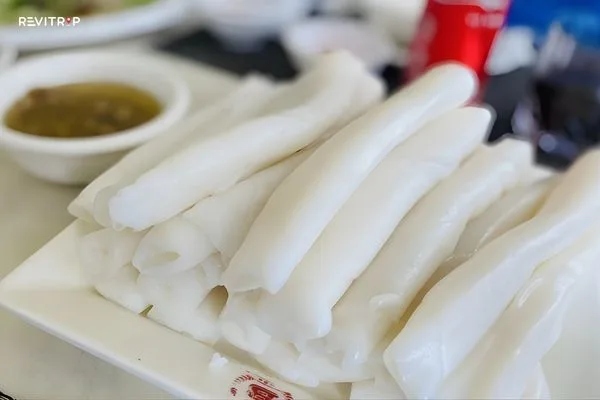
Honest take: Banh gat gu is the easiest Ha Long food experience to slot into a busy day. It is cheap, available everywhere, and takes five minutes to eat. Order it as an afternoon snack between sightseeing and dinner, not as a meal replacement.
Fresh Oysters and Grilled Seafood: The Simplest Version of Ha Long Food
Not everything on this list is obscure. Sometimes the best Ha Long food experience is the most direct: raw oysters from the Gulf, grilled with scallion oil and fried shallots.
Ha Long Bay oysters are plump, clean-tasting, and naturally sweet. The mineral-rich, cold water they grow in makes the difference. Served raw with lime and chili, they taste the way oysters taste when they come off the water that morning. Grilled with cheese is a popular modern preparation, but the scallion oil version remains the local standard.
Around the oysters, the full spread of Ha Long grilled seafood makes for the best communal dinner in the city. Grilled squid with chili sauce, stir-fried spotted babylon snails with salted egg, grilled clams with lemongrass and butter, whole steamed crab with pepper salt: all of it is better eaten close to the water, at a table with several people, with cold beer.
The Ha Long Night Market is the most convenient place to eat this way, with stalls cooking to order from around 5:30 PM. Prices for grilled oysters run 100,000 to 200,000 VND per dozen.
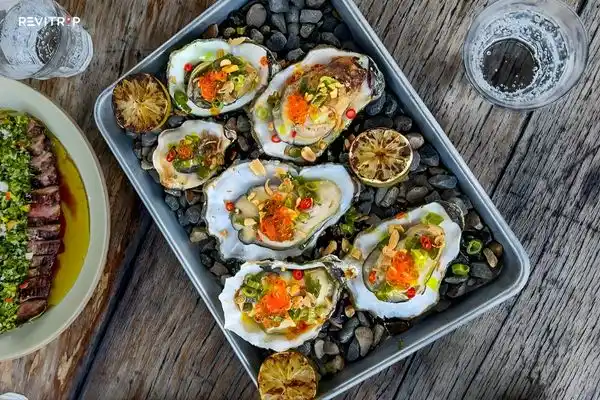
Honest take: The gap between seafood on a cruise boat and seafood at a Bai Chay street stall is not always a gap in quality. It is a gap in atmosphere. Eating fresh grilled oysters at a plastic-stool table with the bay behind you is a better evening than the same oysters served in a cruise dining room.
Quick Reference: Ha Long Food at a Glance
| Dish | Vietnamese Name | Best For | Price Range |
|---|---|---|---|
| Squid cake with rice rolls | Cha muc + banh cuon | Breakfast, must-eat | 35,000–40,000 VND |
| Mantis shrimp noodle soup | Bun be be | Breakfast, locals only | 45,000–80,000 VND |
| Ha Long clam | Ngan | Unique local bivalve | 80,000–150,000 VND |
| Nodding cake | Banh gat gu | Snack, afternoon | 30,000–50,000 VND |
| Fresh oysters and grilled seafood | Various | Evening, communal | 100,000–300,000 VND |
Where to Eat Ha Long Food
Cai Dam Market (Bai Chay): The best local food market in Ha Long City. Stalls open from 6:00 AM and serve bun be be, ngan, and banh gat gu to local residents. No English menus. Point at what the next table is eating.
Gieng Don Street Food Market: A vibrant evening market on Gieng Don Street in the Cao Thang area. Multiple stalls serving Ha Long specialties at affordable prices, with a more local crowd than the Ha Long Night Market.
Ha Long Night Market (Friday to Sunday): The most accessible entry point for Ha Long food, with grilled seafood, ngan, and banh gat gu all in one location. See our Ha Long Night Market guide for the full breakdown of what to order and what to skip.
Hong Hanh 3 Restaurant (50 Ha Long Street, Bai Chay): Widely recommended by locals for cha muc and fresh seafood. More polished than a market stall but not a tourist trap.
Ha Long Food vs. Other Vietnamese Coastal Cities
Ha Long food sits in its own category within Vietnamese coastal cuisine. Compared to Ninh Binh’s best food, which is built on mountain goat, crispy rice, and river eels, Ha Long is entirely ocean-facing. Ha Long meals are simpler and more ingredient-led. The seafood does most of the work, and the preparations exist to highlight freshness rather than add complexity.
The closest comparison in northern Vietnam is Hai Phong, two hours south by road. Hai Phong’s food culture is also coastal and seafood-influenced, but its defining dish is banh da cua (crab noodle soup): heavier, richer, and built on a different cooking personality. Our Hai Phong food tour guide covers the key dishes if you plan to combine both cities.
Further inland, Hanoi’s food is built on pork, herbs, and broth. Our guide to bun dau mam tom in Hanoi is a good entry point for the capital’s street food before you head north. The contrast with Ha Long food could not be sharper.
For a broader view of Ha Long Bay as a destination, our complete travel guide covers how to structure your time between the cruise and the city.
FAQ
For fresh Ha Long food, visit local markets like Cai Dam Market, Ha Long 1 & 2 Markets, or the early morning Hon Gai Seafood Market.
For evening dining, seafood, and souvenirs, visit Ha Long Night Market (Bai Chay) (6 PM – 11 PM). Top local specialties include squid sausage (chả mực), dried seafood, and fresh fish.
The Ha Long Night Market (also known as the Bai Chay Night Market) is a vibrant open-air market in the heart of Ha Long City’s tourist hub.
Shopping in Ha Long Bay offers a blend of traditional open-air markets, such as the vibrant Ha Long Night Market, and modern commercial centers like Vincom Plaza Ha Long.