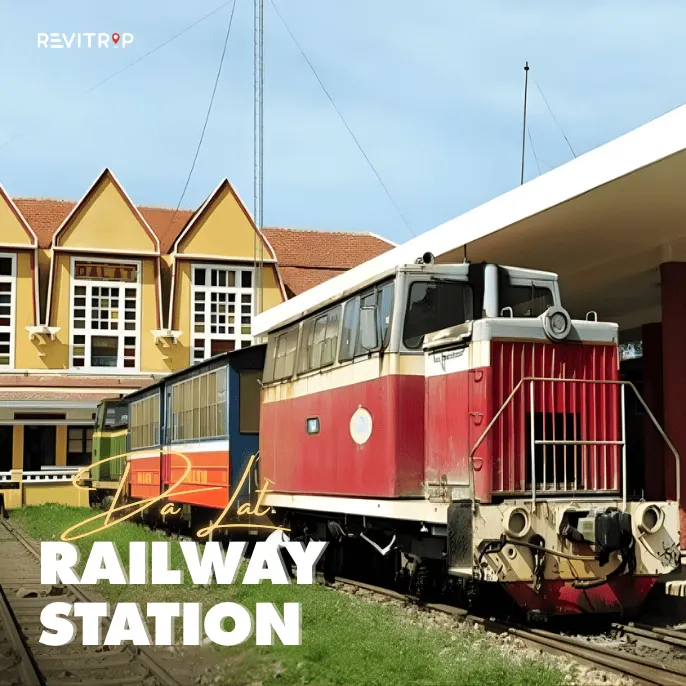
Some places in Da Lat ask very little from you. They do not need a big plan, a full morning, or a list of things to tick off. They only ask that you arrive a little slower than usual. Da Lat Railway Station is one of those places.
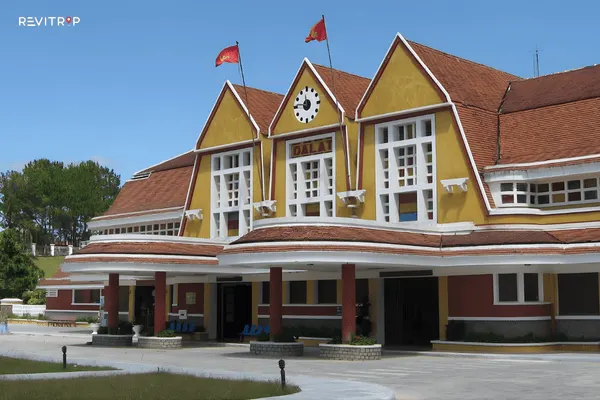
You see it first in its lines and color – that pale yellow facade, those sharp roof peaks, the quiet symmetry of a station that seems to belong to another rhythm. Then you begin to notice the feeling around it. The air is cooler here. The light lands softly on the old walls. Even the tracks seem to hold memory.
In a city known for mist, pine hills, flower gardens, and lakeside afternoons, Da Lat Railway Station adds something else: a small, beautiful sense of departure.
A place worth visiting, even if you never board the train
Yes, Da Lat Railway Station is worth visiting. It is one of the city’s most charming landmarks, tied to the old Thap Cham – Da Lat railway and still used today for tourist trains on the short route to Trai Mat, where many visitors continue on to Linh Phuoc Pagoda.
What makes it memorable is not speed or grandeur. The route is short, the station is modest in scale, and yet the whole place carries a gentle romance that fits Da Lat perfectly. You come for the architecture, for the old tracks, for the feeling of standing in a mountain city where travel once sounded like wheels and whistles instead of engines and horns.
The prettiest kind of old-world charm
Da Lat has always worn its past lightly. The city still keeps traces of its French-era history in churches, villas, hotels, and public buildings. The railway station is named among Da Lat’s charming colonial-era landmarks, set within a town shaped by European-inspired architecture, lakes, and highland air.
The station itself was built in 1932 and completed in 1938. It stands more than 1,500 metres above sea level and once served as the main station on the old Thap Cham – Da Lat line. That long mountain railway became famous for its engineering ambition, but even without knowing any of that history, the station still has presence. It feels composed, elegant, and slightly wistful, as if it has been waiting patiently for someone to look up and notice it properly.
This is why the station works so well in Da Lat. The city has never been at its best when rushed. It belongs to sweater weather, early coffee, lake walks, and late afternoons that fade gently. A railway station from another era fits that mood all too well.
The station beyond the photograph
A lot of travelers come here because the building is beautiful, and that is fair enough. It photographs well from almost every angle. But if you stop there, you miss the better part.
The deeper charm of Da Lat Railway Station is that it still gives you a way to move through the city differently. Da Lat’s tracks no longer connect to Vietnam’s north-south railway, but the restored section to Trai Mat remains active as a tourist route.
The station is not only a relic to admire. It is still a threshold. It still lets you leave, if only for a little while.
And perhaps that is what makes it feel romantic. Not romance in the obvious sense. More the quiet romance of motion, of old departures, of windows framing greenhouses and pine shadows, of a city that still knows how to slow the world down.
Da Lat feels softer with a short train ride
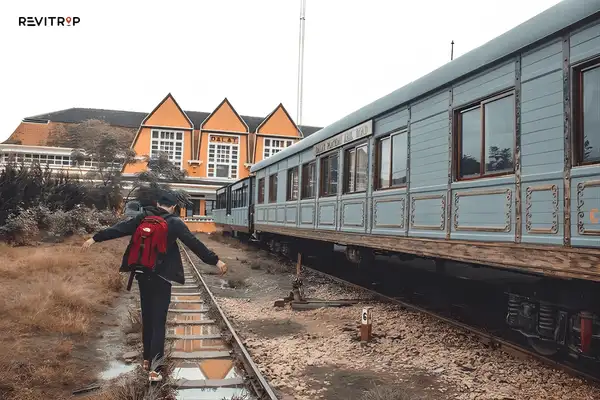
The ride from Da Lat to Trai Mat is only about seven kilometres, but it carries more feeling than distance. The route is a way to admire the beauty of Da Lat from the center out toward the quieter edges of the city. The journey lets visitors take in the scenery on the way to Trai Mat and Linh Phuoc Pagoda.
That shortness is part of the appeal. The journey never tries too hard. It does not need to. You sit by the window and let the city loosen around you. Roofs thin out. Greenhouses appear. The landscape becomes more open, more highland, more tender somehow. It feels less like sightseeing and more like being carried gently into a quieter thought.
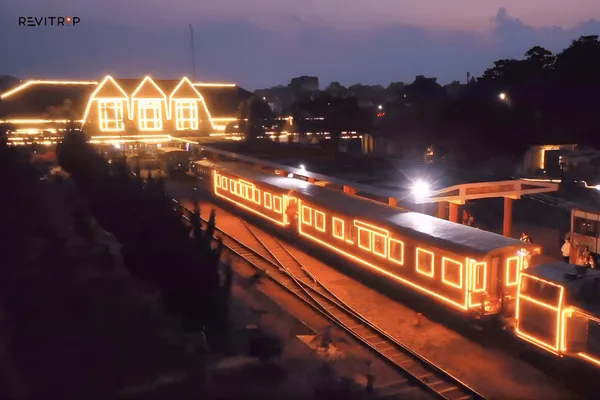
In 2024, Da Lat also began operating night tourist trains on this route, adding another layer to the experience for visitors who want to see the old station lit differently after dark.
How to feel the station at its best
If you want the most beautiful version of Da Lat Railway Station, go in the morning or later in the afternoon. Morning gives you clean light and a calmer atmosphere. Late afternoon gives the building a softer glow, and the colder air begins to settle into the city in that familiar Da Lat way.
This is also a place that rewards unhurried timing. Give yourself space to linger. Look at the platform. Watch people arriving and leaving. Sit for a while if you can. If you plan to ride to Trai Mat, leave enough time for the journey and for the stop beyond it. A rushed visit can still be pleasant, but the station opens up more fully when you let it breathe.
Who will fall in love with this place
Da Lat Railway Station is perfect for travelers who like their memories a little quieter. It suits couples, first-time visitors, photographers, and anyone drawn to places with a soft historical texture. It also works beautifully for people who enjoy small experiences more than big attractions.
If you are looking for adrenaline, this may not be the highlight of your trip. But if you love old architecture, mountain air, faded romance, and the feeling that a place can hold time inside it, then yes, this is one of the stops in Da Lat that you should not miss.
The kind of memory that stays gentle
There are louder places in Da Lat. There are grander viewpoints, busier markets, and more obvious attractions. Yet Da Lat Railway Station has something many of them do not. It leaves behind a mood.
You remember the yellow walls. The tracks stretching out. The cold light on the roofline. The little thrill of an old train still moving through a city built for softness. You remember that for a brief hour, travel felt unhurried again.
And that may be the most romantic thing about it.
It reminds you that not every journey has to be long to stay with you.
FAQ
As of the latest local updates, the general sightseeing entrance fee for Da Lat Railway Station is VND 50,000 per visitor. Children under 6 years old or under 1.32 metres are exempt, and passengers who already hold a Da Lat – Trai Mat train ticket are also exempt from the separate sightseeing fee.
Da Lat Railway Station was built from 1932 to 1938 during the French colonial period. It served as the main station of the former Thap Cham – Da Lat railway, stood at over 1,500 metres above sea level, and today survives as both a historic landmark and a tourism-focused station for the restored route to Trai Mat.
Yes, 2 days in Da Lat is enough for a first visit, especially if you want the essentials – the lake, the market, a café morning, the railway station, and one softer outing such as Trai Mat or Tuyen Lam. That said, Da Lat has enough architecture, outdoor activities, coffee culture, and countryside charm that 3 days feels better if you want to enjoy it at the city’s natural pace.