Before you go, let me be upfront: Bai Dinh Pagoda does not feel like the other sacred sites in Ninh Binh. It is not quiet. It is not hidden. It will not sneak up on you the way Bich Dong Pagoda does, or move you the way Hoa Lu Ancient Capital does. Bai Dinh Pagoda hits you over the head with scale. And honestly? That is the point.
This is the largest Buddhist temple complex in Southeast Asia. It holds nine national and regional records. It welcomes millions of visitors a year. Once you accept that Bai Dinh Pagoda is a grand, somewhat overwhelming, deeply Vietnamese spectacle rather than a peaceful spiritual retreat, the visit starts to make a lot more sense and you start to enjoy it on its own terms.
Here is an honest look at what you will find, what to expect, and how to visit Bai Dinh Pagoda without wasting your time.
What Is Bai Dinh Pagoda?
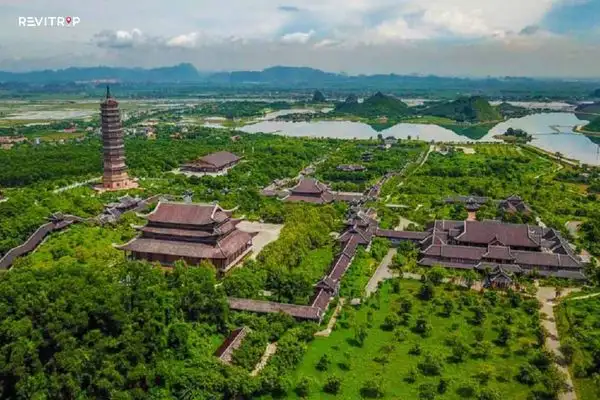
Bai Dinh Pagoda, or Bai Dinh Pagoda Spiritual and Cultural Complex, sits on Bai Dinh Mountain in Gia Vien District, Ninh Binh Province, about 15 km from Ninh Binh city and 95 km from Hanoi. The complex covers a staggering 539 hectares total, divided into the ancient pagoda and the new Bai Dinh Pagoda area, which alone spans 80 hectares.
The name “Bai Dinh” means “heading to Dinh Mountain,” and the mountain itself carries deep historical weight. Emperor Dinh Tien Hoang, the founding ruler of Vietnam’s first independent dynasty (whose temples you can visit at Hoa Lu Ancient Capital), climbed this mountain to pray for favorable weather before battle. The ancient Bai Dinh Pagoda in the caves above was founded in 1136 by Zen Master Nguyen Minh Khong during the Ly Dynasty. The newer complex, built from 2003 and completed in 2010, surrounds and dwarfs it.
The Records: What Makes Bai Dinh Pagoda Famous
Bai Dinh Pagoda holds nine records as of 2012, and they help explain the scale you encounter when you arrive.
| Record | Detail |
|---|---|
| Largest Buddhist complex in Vietnam | 539 hectares total area |
| Largest bronze gilded Buddha statue in Asia | 100-ton bronze statue in the Hall of Buddha |
| Tallest stupa in Asia | Xa Loi Stupa, 99 meters, 13 floors |
| Longest Arhat corridor in Asia | Nearly 3 km, lined with 500 stone statues |
| Most Arhat statues in Vietnam | 500 statues, each carved differently |
| Largest bronze bell in Vietnam | Dai Hong Chung, 36 tons, 5.5m high |
| Largest Bodhi tree garden in Vietnam | Trees brought directly from India |
| Largest bronze Maitreya Buddha in Southeast Asia | 80-ton statue, 10 meters high |
| Largest pagoda area in Vietnam (2010) | New pagoda complex at 80 hectares |
Reading these records before you visit sets the right expectations. Bai Dinh Pagoda is built to impress through superlatives. It succeeds completely.
The Two Pagodas: Old vs New
One of the things that confuses first-time visitors is that Bai Dinh Pagoda is actually two very different places sharing one name.
The Old Bai Dinh Pagoda
The ancient pagoda sits 800 meters from the new complex, reached via over 300 stone steps climbing through the forest. Most visitors skip it entirely, which is a mistake. Up here, two natural caves open into the mountain: the Bright Cave on the right, where Buddha and mountain gods are venerated, and the Dark Cave on the left, dedicated to the Mother Goddesses of Vietnamese folk religion. The Dark Cave runs through seven chambers, some high and open, some requiring you to crouch through narrow rock passages. Candles line the stone surfaces, casting the various statues in flickering light.
The old pagoda feels like a living place of worship rather than a tourist site. The stone is mossy, the air is cool, and local worshippers visit regularly. If you come to Bai Dinh Pagoda for spiritual atmosphere, this is where you find it.
The New Bai Dinh Pagoda
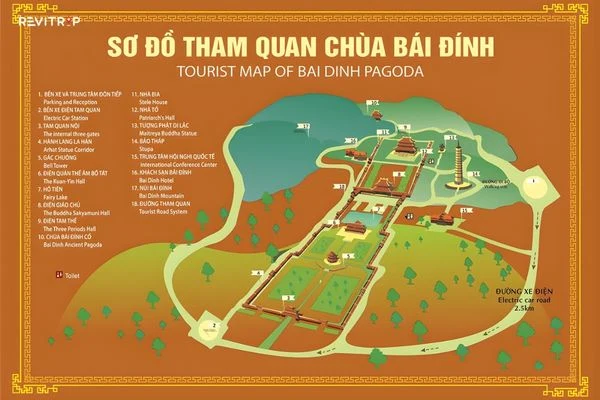
The new complex is where the records live. Starting from the Tam Quan Gate, the main entrance, you walk along the Arhat Corridor: nearly 3 km lined with 500 stone statues of Buddhist saints, each carved in a different posture and expression by artisans from Ninh Van stone village. No two are the same. Walking the full length takes 20-30 minutes at a relaxed pace, and the corridor itself is genuinely impressive.
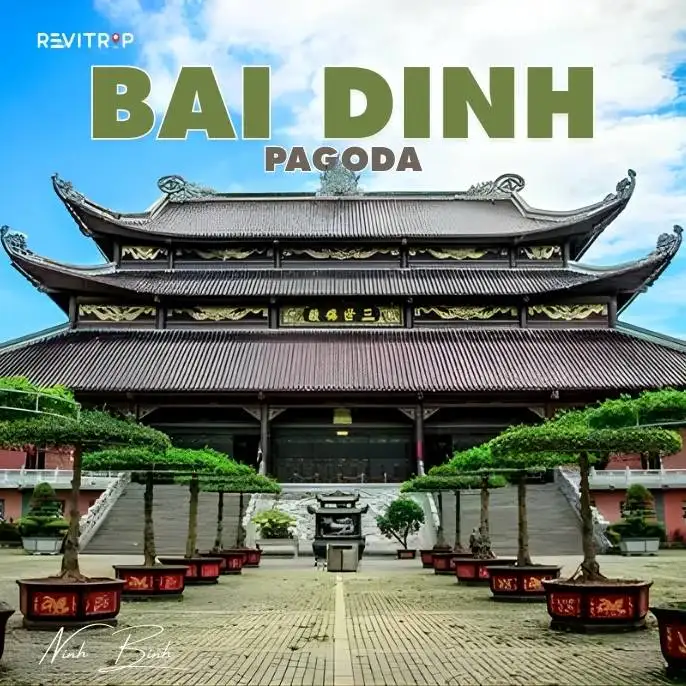
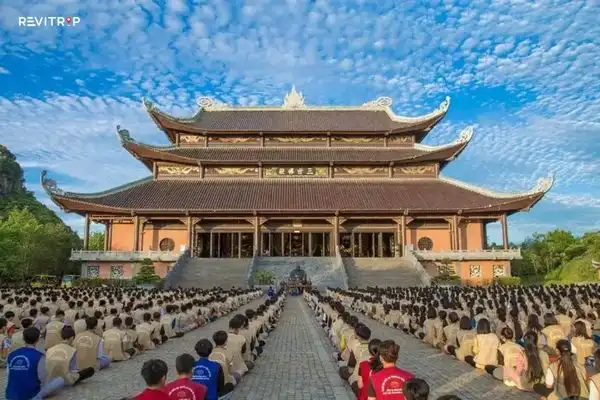
From the corridor, the complex opens into a sequence of grand halls: the Bell Tower at 22 meters, the Hall of Guan Yin, the Hall of Buddha housing the 100-ton gilded bronze statue, and finally Tam The Hall, the largest structure, at 34 meters high and 59 meters long. The Xa Loi Stupa rises 99 meters above everything.
The building materials are deliberately local: Ninh Binh green stone, ironwood, dark brown Bat Trang glazed tiles. The craftsmanship inside comes from Vietnam’s most famous traditional villages: bronze from Y Yen, stone carving from Ninh Van, woodwork from Phu Loc, embroidery from Ninh Hai. The scale is enormous, but the details are genuinely fine.
Honest Review: What It Actually Feels Like
Walking into Bai Dinh Pagoda for the first time, the size hits you before anything else. The Arhat Corridor stretches further than you expect. The halls are taller than they look in photographs. The 100-ton Buddha inside the Hall of Buddha stops you when you step through the entrance door: it is simply enormous, and it is beautiful.
What is equally true is that Bai Dinh Pagoda gets very crowded, especially on weekends and during the spring festival season between January and March. During peak times, the Arhat Corridor fills with tour groups, incense smoke drifts through the halls, and the atmosphere swings between contemplative and chaotic.
The electric car service (around 30,000 VND per person) connects the entrance to the main halls and is worth taking on a hot day. Bai Dinh Pagoda covers so much ground that walking the full complex in the heat takes real stamina. Many visitors take the electric car to the far end and walk back, which gives you the corridor and hall experience without the slog.
One thing that genuinely surprised me: the old pagoda up the 300 steps. Most tour groups do not make the climb. The moment you step away from the new complex and start up the hillside, the crowd thins dramatically. The Bright Cave and Dark Cave at the top are the quietest, most atmospheric spaces in the entire Bai Dinh Pagoda complex, and the contrast with the scale of the new buildings below makes them feel all the more significant.
When to Visit Bai Dinh Pagoda
The Bai Dinh Pagoda Festival runs from the 6th day of the first lunar month, typically in January or February, for several weeks into spring. This is the most vibrant time to visit Bai Dinh Pagoda: the complex fills with worshippers, ceremonies, and traditional music. It is also the busiest and most crowded period by a significant margin.
For a quieter visit, November to December offers cooler weather, smaller crowds, and pleasant light on the stone corridors. Early morning visits on weekdays, arriving before 8:00 AM, give you the Arhat Corridor and the main halls in near-silence before the tour groups arrive. That version of Bai Dinh Pagoda is a genuinely moving experience.
Summer (May to August) is hot, humid, and crowded. If you visit in summer, take the electric car and bring water.
Practical Information
| Detail | Info |
|---|---|
| Location | Gia Sinh Commune, Gia Vien District, Ninh Binh Province |
| Opening hours | 7:00 AM – 6:00 PM daily |
| Entrance fee | Free |
| Electric car | 30,000 VND per person (recommended) |
| Distance from Ninh Binh city | ~15 km (~25 min by car) |
| Distance from Hanoi | ~95 km (~2 hours by car) |
| Distance from Hoa Lu | ~7 km (~15 min by car) |
| Distance from Trang An | ~10 km (~15 min by car) |
| Time needed | 2-3 hours for new complex; add 1 hour for old pagoda caves |
| Dress code | Cover shoulders and knees; no shorts or sleeveless tops in halls |
Tips Before You Visit Bai Dinh Pagoda
Take the electric car, at least one way. Bai Dinh Pagoda is enormous, and walking the full complex in Vietnam’s heat is tiring. Take the electric car to the far end and walk back through the Arhat Corridor. You see everything, in the right order, without exhausting yourself before the main halls.
Do not skip the old pagoda. The 300 steps to the ancient caves are the most underrated part of Bai Dinh Pagoda. The crowds disappear, the atmosphere shifts completely, and you get the cave temple experience that the new complex, for all its grandeur, cannot replicate.
Bring cash for the electric car and any donations. The pagoda entrance is free, but the electric car costs 30,000 VND and is cash only. There are no ATMs inside Bai Dinh Pagoda.
Dress appropriately before you arrive. Shoulders and knees must be covered inside all halls. Some vendors near the entrance sell wraps and sarongs, but bringing your own saves money and the stress of being turned away at the door.
Go early or late on weekdays. Bai Dinh Pagoda is most peaceful before 8:00 AM and after 4:00 PM. Midday on weekends during the spring festival season is genuinely overwhelming for anyone who prefers a contemplative visit.
How Bai Dinh Fits Into a Ninh Binh Itinerary
Bai Dinh Pagoda pairs naturally with Trang An on the same day: both sites sit close together west of Ninh Binh city, and the contrast between Trang An’s intimate boat-through-caves experience and Bai Dinh’s grand architectural scale makes for a satisfying full day of variety. A boat tour at Tam Coc or Trang An in the morning, lunch, then Bai Dinh Pagoda in the afternoon is one of the most common and effective Ninh Binh day structures. If you are still deciding between the boat options, our guide to Trang An vs Tam Coc covers the differences clearly.
If you are building a longer Ninh Binh itinerary, Bai Dinh Pagoda combines well with Hoa Lu Ancient Capital nearby, or with Cuc Phuong National Park as a full nature-and-culture two-day sequence.
For accommodation, Tam Coc Garden Resort and Ninh Binh Hidden Charm Hotel & Resort both sit within 15-20 minutes of Bai Dinh Pagoda and offer comfortable bases for exploring the wider region.
Is Bai Dinh Pagoda Worth Visiting?
Yes, but go in with clear expectations. Bai Dinh Pagoda is not a place for quiet reflection on a busy weekend. It is a place for architectural wonder, cultural immersion, and a genuine encounter with the scale of Vietnamese Buddhist ambition. The Arhat Corridor alone justifies the trip. The 100-ton gilded Buddha stops you in your tracks. And the old pagoda caves above, which most visitors never find, deliver the spiritual intimacy the new complex cannot.
Give it two to three hours. Climb the 300 steps. Take the electric car back. You will not regret going.
FAQ:
Electric car buggies are available at Bai Dinh Pagoda to transport visitors from the ticketing office to the main temple areas, costing approximately 150,000 VND.
Entrance to the main grounds of Bai Dinh Pagoda in Ninh Binh is free. However, costs apply for specific services:
– Electric buggies cost 30,000–60,000 VND per way.
– Ascending the Bao Thap Tower costs approximately 50,000 VND.
– Parking fees are roughly 15,000 VND for motorbikes and 40,000 VND for cars.
The choice between Bai Dinh Pagoda and Hoa Lu Ancient Capital depends on whether you prefer modern grandeur or historical significance. Read our Hoa Lu Ancient Capital article to compare.