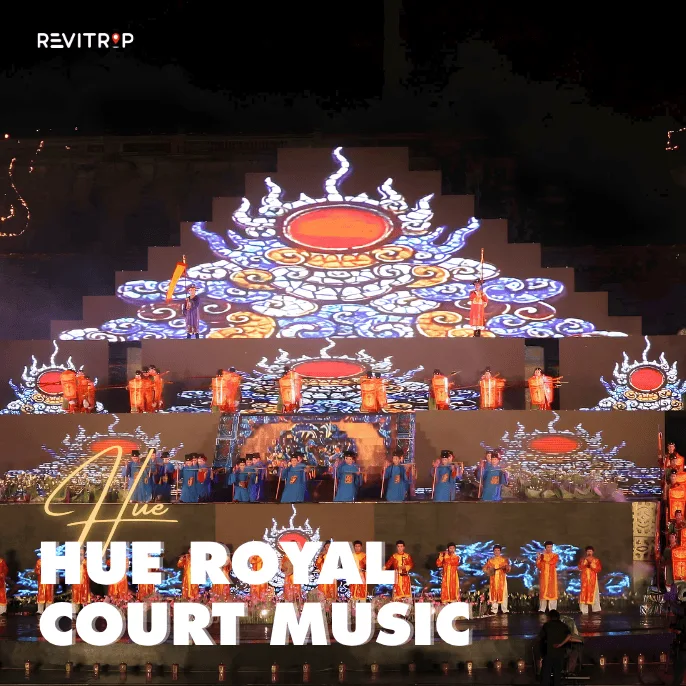
Hue moves at its own pace, and Nha Nhac fits into that rhythm naturally.
There is a certain steadiness you notice almost immediately in the city – in the quiet stretches around the citadel, in the way spaces open and settle instead of overwhelming you. Nha Nhac carries that same rhythm. It moves with control, with structure, and with a kind of calm that feels deeply tied to Hue itself. If you are exploring intangible culture heritage in Vietnam, this is one of the experiences that feels most grounded in place.
Nha Nhac and Vietnam’s cultural memory
Nha Nhac, often translated as Hue royal court music, comes from the imperial court of the Nguyen dynasty. It was performed during ceremonies, royal anniversaries, religious occasions, coronations, funerals, and official receptions, with each element following a precise order. UNESCO first proclaimed it in 2003 and later included it on the Representative List of the Intangible Cultural Heritage of Humanity in 2008.
That background still shows in the way it is performed today. The rhythm is controlled, the movements are deliberate, and the entire performance feels carefully arranged rather than expressive in a spontaneous way.
When people think about heritage in Vietnam, they often picture architecture first. If you are exploring the cultural side of central Vietnam more deeply, My Son Sanctuary adds another layer to the same journey – older, quieter, and shaped by a different historical world.
Nha Nhac sits in a different category. It is not something you walk through or photograph. It exists through sound, timing, and the ability of performers to carry it forward.
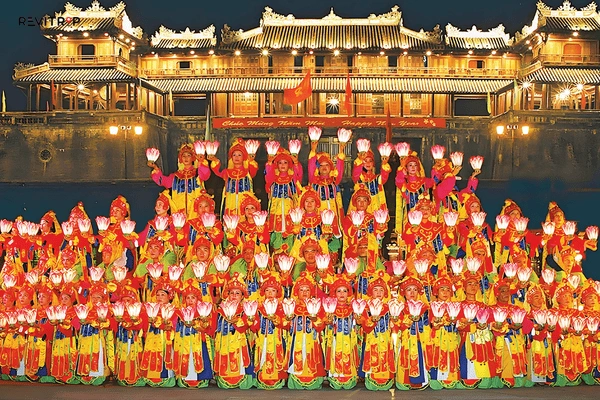
Experiencing Nha Nhac in Hue
In Hue, Nha Nhac feels exactly where it should be.
The city already holds a quiet, ceremonial atmosphere, and the music settles into it without effort. The old imperial setting, the slower pace, and the sense of restraint all align naturally with the performance. Nothing feels adjusted or relocated.
Because of that, the experience comes across as whole. The music, the space, and the atmosphere move together in a way that feels calm, precise, and deeply rooted.
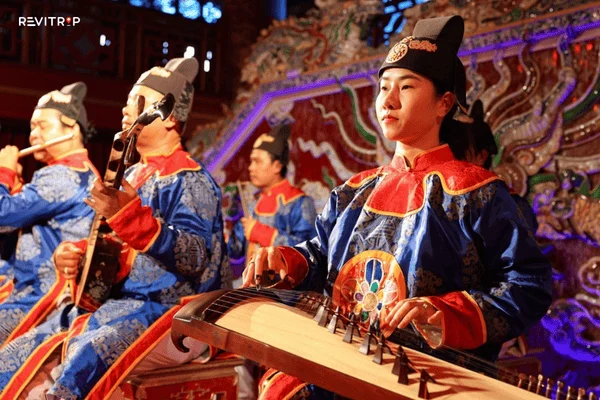
An elegant heritage form with real presence
Nha Nhac is not built around dramatic moments or quick emotional impact. It leans on precision instead.
Each section unfolds in a measured way, with attention to timing, costume, and movement. The performance carries a certain distance, but not in a cold sense. It reflects a system where everything has a place and a purpose.
Even without knowing the full historical background, it is easy to notice how structured the entire experience is. The consistency, the pacing, and the control all point back to its origins in the royal court.
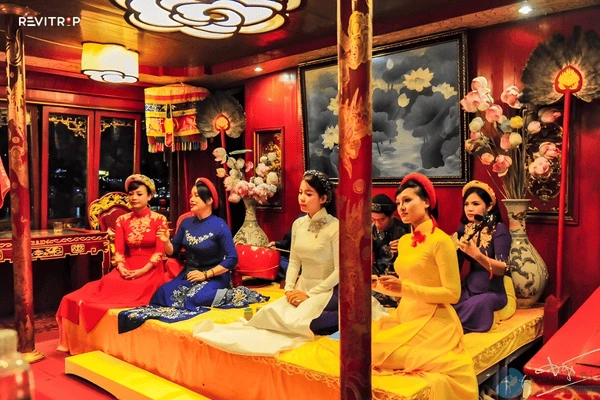
Nha Nhac as a living intangible culture heritage in Vietnam
What keeps Nha Nhac relevant is that it is still being performed and passed on.
This is what defines intangible culture heritage in Vietnam. It is not preserved in a fixed form. It continues through people who learn it, practice it, and keep it part of the present.
In Hue, that continuity is visible. The performances are not only about showing what existed in the past. They keep the tradition active in a way that still feels close to its original form.
What stays with you after
Nha Nhac unfolds slowly and leaves behind a quiet sense of order.
Hue is often experienced through its citadel, tombs, and historic structures, but the music brings the ceremonial layer of the city into focus in a different way. It adds rhythm and presence to what might otherwise feel still.
Within intangible culture heritage in Vietnam, Nha Nhac remains closely tied to its original setting. In Hue, it feels natural, unforced, and fully part of the city’s character.
If you spend time here, this is one experience worth hearing at least once.
Many travelers visit Hue and Hoi An on the same trip, and the shift from imperial atmosphere to old-town charm makes the journey feel richer.
FAQ
Nha Nhac Hue dates back several centuries, with roots developing as early as the Ly and Tran dynasties, and reaching its most refined form under the Nguyen dynasty in Hue.
If you are building a deeper cultural route through central Vietnam, our Da Nang guide is another good place to continue.
Nhã nhạc cung đình Huế includes a mix of traditional instruments such as drums, gongs, flutes, string instruments, and various types of lutes and zithers. Each instrument plays a specific role within the structured ensemble.
Yes. Nhã nhạc cung đình Huế dance is an important part of the performance, combining music with choreographed movements, costumes, and ceremonial gestures that reflect imperial rituals.