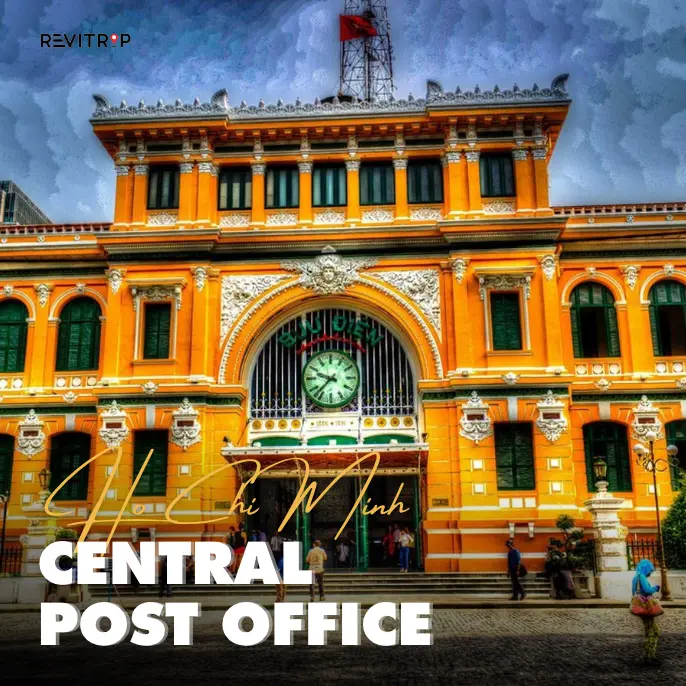
Some buildings just stop you in your tracks. Saigon Central Post Office is one of them. It stands at 2 Paris Commune Square in the heart of District 1. This extraordinary French colonial building has served the city for over 130 years. It is one of the oldest functioning post offices in Southeast Asia. Moreover, it is one of the finest surviving examples of 19th century French architecture in Vietnam. Best of all, entry is completely free. Whether you come for the history, the architecture, or simply to send a postcard home, Saigon Central Post Office delivers a genuinely memorable experience.
Essential Information Before You Visit
Before heading to Saigon Central Post Office, a few practical details are worth knowing. The building sits at 2 Paris Commune Square, Ben Nghe Ward, District 1. It is just a one-minute walk from Notre Dame Cathedral. Entry costs nothing. Furthermore, the post office remains fully operational. You can buy stamps, send postcards, and use postal services during your visit.
The best time to arrive is between 8am and 10am, or between 4pm and 6pm. Both windows offer cooler temperatures and smaller crowds. Plan to spend around 30 to 45 minutes exploring the interior and exterior. Inside, look out for the large portrait of President Ho Chi Minh above the main counter. Additionally, two antique maps of Saigon from the 1800s hang on the walls, and a row of beautifully preserved wooden telephone booths lines one side of the hall.
Booking Tours to Ho Chi Minh City
How to Get to Saigon Central Post Office
The building sits in one of the most accessible parts of Ho Chi Minh City. As a result, reaching it is straightforward regardless of your starting point.
The easiest option is a ride-hailing app like Grab or Be. Simply type “Saigon Central Post Office” and the driver will take you directly to the entrance. From Tan Son Nhat Airport, the fare runs approximately VND 120,000 to VND 180,000. From Ben Thanh Market, expect to pay around VND 30,000 to VND 50,000.
If you enjoy exploring on two wheels, renting a motorbike gives you full flexibility. Several rental companies operate in District 1, with daily rates starting from around VND 100,000. Parking is available near Notre Dame Cathedral and the Book Street for VND 5,000 to VND 10,000.
For those staying nearby in District 1, walking is the most pleasant choice. Notre Dame Cathedral is just one minute away on foot. Nguyen Hue Walking Street takes around ten minutes. Ben Thanh Market is approximately fifteen minutes away and the route passes through some of the most architecturally interesting streets in the city.
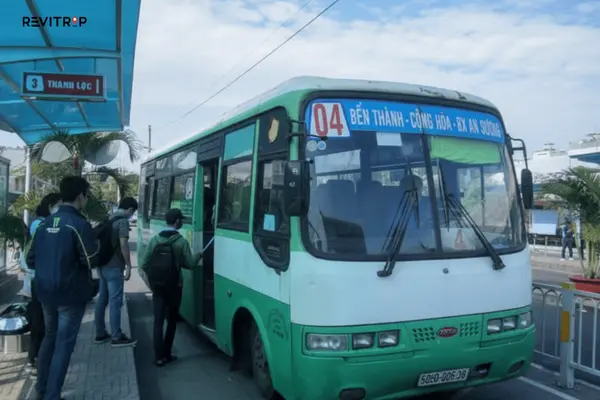
Budget travelers can also take a public bus. Routes 04, 06, 19, 30, and 36 all stop near the Paris Commune Square terminal. That stop is just a one-minute walk from the entrance. Bus fares cost VND 5,000 to VND 7,000 per trip.
A Brief History of Saigon Central Post Office
Saigon Central Post Office has a history stretching back to 1886. At that time, French colonial authorities began construction as part of a broader effort to modernize Vietnam’s postal and communications infrastructure. The building completed in 1891 and quickly became the primary postal and telegraph hub for French Indochina.
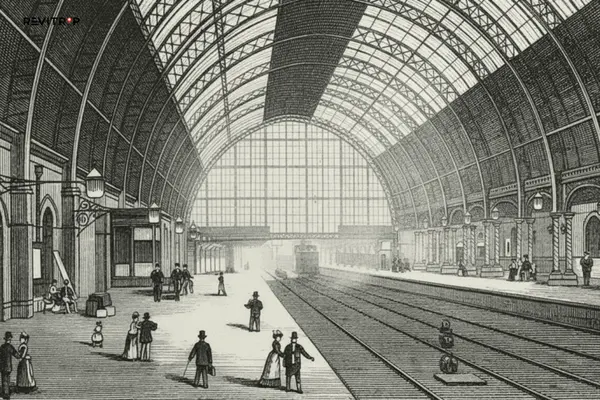
Contrary to a popular misconception, Gustave Eiffel himself did not design the building. Instead, engineers from his company created the plans. They drew inspiration from the great railway stations of 19th century Europe. The result was a structure combining functional communication infrastructure with architectural grandeur rarely seen in the region at the time.
Two large antique maps inside the building reflect this communications history. The first, dated 1892, shows Saigon and its surrounding districts as they appeared during the colonial era. The second, from 1936, maps the telegraph lines connecting southern Vietnam and Cambodia. Together, they reveal how Saigon Central Post Office sat at the center of regional communication networks.
Architectural Highlights Worth Noticing
The French Colonial Exterior
The first thing visitors notice is the vivid yellow facade with white trim. This Neo-Renaissance design draws inspiration from the grand railway stations of 19th century Europe. It features rows of arched windows, decorative ironwork, and a symmetrical layout that gives the building a sense of composed elegance. Between the green arched windows on the upper facade, names of European scientists significant to the history of electricity and telegraphy appear inscribed in the stonework. This detail rewards visitors who look closely.
The Grand Arched Entrance
The central entrance arch creates a strong visual statement. Decorative stone carvings, floral motifs, and Neo-Renaissance sculptural details frame the doorway on all sides. A large clock sits above the arch, adding both a practical function and a visual focal point to the facade. Stepping through this entrance feels like crossing from the busy streets of modern Saigon into an entirely different era.
The Vaulted Interior
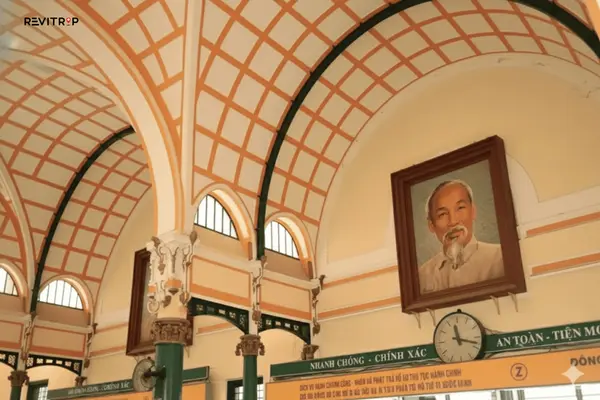
Inside, the barrel-vaulted ceiling immediately draws your eye upward. Iron columns support the vault while keeping the interior hall open and uncluttered below. Natural light enters through the arched windows along both sides of the hall. As a result, the space feels warm and airy rather than heavy or oppressive. The combination of high ceilings, symmetrical layout, and carefully preserved decorative details gives the interior a grandeur that many visitors find genuinely unexpected.
The Historical Maps and Wooden Phone Booths
Along the interior walls, two antique maps give the building a documentary quality beyond simple aesthetics. These maps connect the physical space to its original purpose. Moreover, they remind visitors that Saigon Central Post Office was once the nerve center of communication across the entire region.
Alongside the maps, a row of vintage wooden telephone booths lines one wall of the main hall. These booths no longer operate. However, they remain in excellent condition and represent one of the few surviving examples of early Vietnamese telecommunications infrastructure. Consequently, they have become one of the most popular photography spots in the building.
The Portrait of Ho Chi Minh
Above the main service counter, a large portrait of President Ho Chi Minh commands the far end of the hall. The placement of this portrait inside a French colonial building creates a powerful visual contrast. It summarizes much of Vietnam’s complex modern history in a single image. Furthermore, the vaulted ceiling draws the eye naturally toward the portrait. This makes it feel like a deliberate and considered centerpiece of the entire interior.
Nearby Attractions to Combine With Your Visit
Saigon Central Post Office sits within easy walking distance of several other major landmarks. Notre Dame Cathedral is just one minute away and offers another striking example of French colonial religious architecture. In addition, the Nguyen Van Binh Book Street is two minutes on foot and worth a browse for Vietnamese literature and local publishing. The Reunification Palace is around ten minutes away. It provides essential historical context for understanding modern Vietnam. Nguyen Hue Walking Street is also within easy reach and comes alive with activity every evening.
Saigon Central Post Office works on every level. It is beautiful from the outside, fascinating on the inside, free to enter, and still genuinely useful as a working post office. Furthermore, it sits at the center of some of the best urban walking in all of Ho Chi Minh City. For more inspiration on exploring the city, check out our guides on street food in Ho Chi Minh City, Ho Chi Minh City travel guide, and is Ho Chi Minh City worth visiting.
FAQ
Yes, entry is completely free. The building functions as a working post office, so visitors can also buy stamps, send postcards, and use postal services during opening hours.
Yes. The building sells Vietnamese stamps, postcards, and traditional gifts. These make for lightweight and meaningful souvenirs that connect directly to the history of the place.
Most visitors find 30 to 45 minutes sufficient to explore the exterior, walk through the main hall, examine the historic maps and phone booths, and take photographs. Combining it with nearby Notre Dame Cathedral and Nguyen Hue Walking Street makes for a full half-day in the area.