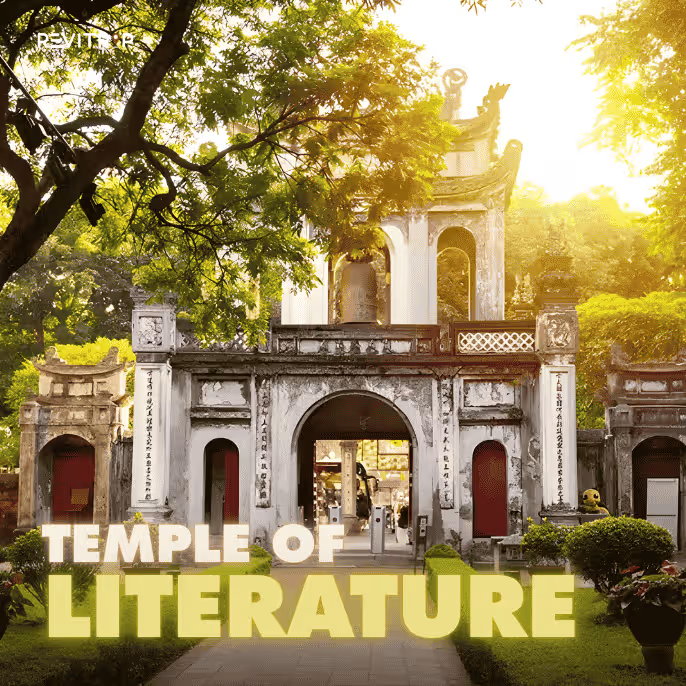
The Temple of Literature in Hanoi is one of the most visited and historically significant sites in Vietnam. Built in 1070, it served as the country’s first national university and remains a living symbol of Vietnamese scholarship and cultural heritage. Located in the heart of the capital, the complex draws visitors who come for its architecture, its history, and the quiet it offers against the pace of the surrounding city. Whether you are planning a first visit or returning with more time to explore, this guide covers everything you need to know before you go.
1. About the Temple of Literature
Address: 58 Quoc Tu Giam Street, Van Mieu, Dong Da District, Hanoi
The Temple of Literature sits at the intersection of four busy streets: Nguyen Thai Hoc, Van Mieu, Quoc Tu Giam, and Ton Duc Thang. Note that many of the surrounding roads are one-way, so plan your approach in advance. The complex served as Vietnam’s first national university and has produced generations of scholars across nearly a thousand years of history. It honors three enlightened kings of Vietnamese history: Ly Thanh Tong, Ly Nhan Tong, and Le Thanh Tong. In 1962, the site received official recognition as a National Historical Relic.
“The Temple of Literature is not simply an ancient ruin. It is the place where Vietnamese intellectual life began, and that beginning still feels present in every courtyard and stone tablet within its walls.”
History
The Temple of Literature dates to 1070, built during the reign of King Ly Thanh Tong. Its original purpose was to honor Confucius, the Duke of Zhou, and the Four Sages. In 1076, King Ly Nhan Tong added the Quoc Tu Giam, a school established to educate the sons of royalty and noble families.
During the Tran dynasty, the institution expanded its reach. Under Emperor Tran Thai Tong, it accepted talented students from ordinary families and changed its name to Quoc Hoc Vien. The reign of King Le Thanh Tong introduced the tradition of erecting stone steles to honor doctoral graduates, a practice that continues to define the site today. When the Nguyen dynasty moved the capital to Hue, a new Quoc Tu Giam was established there and the Hanoi complex was renamed Van Mieu Ha Noi. In 1947, French artillery damaged sections of the complex, leaving only the foundation, two columns, and four stone inkwells standing in the affected area.
Opening Hours and Ticket Prices
The Temple of Literature opens every day of the week. Visitors must purchase tickets at the entrance gate before entering.
| Visitor Category | Ticket Price |
|---|---|
| Adults | 70,000 VND |
| Vietnamese students (with valid student ID) | 35,000 VND |
| People with disabilities and Vietnamese seniors aged 60 and above (with ID) | 35,000 VND |
| Children under 16 | Free |
| Automatic audio guide in foreign languages | 100,000 VND |
Opening hours: 8:00 am to 5:00 pm daily
Note: Opening hours and ticket prices may change. Contact the site management directly for the most current information before your visit.
How to Get There
The Temple of Literature sits within easy reach of Hoan Kiem Lake and the Old Quarter. Several transport options cover the route.
- By personal vehicle or motorbike: From Hoan Kiem Lake, take Trang Thi Street, then Nguyen Khuyen Street, then Hai Ba Trung Street. Parking is available adjacent to the main entrance at 58 Quoc Tu Giam Street.
- By public bus: Multiple bus routes serve the area including lines 38, 41, E08, and 08A. The correct route depends on your starting point across the city.
- By ride-hailing app: Grab, Be, and other ride-hailing services cover the route from anywhere in central Hanoi. This is the most straightforward option for groups or travelers with luggage.
For a broader overview of getting around Hanoi and Vietnam, our transportation in Vietnam guide covers every option from public buses to domestic flights.
2. What to See Inside the Temple of Literature
The Temple of Literature complex divides into five distinct courtyards, each serving a different historical function. Moving through them in sequence gives a clear sense of how the site evolved from a place of worship into a functioning center of education.
The Five Courtyards
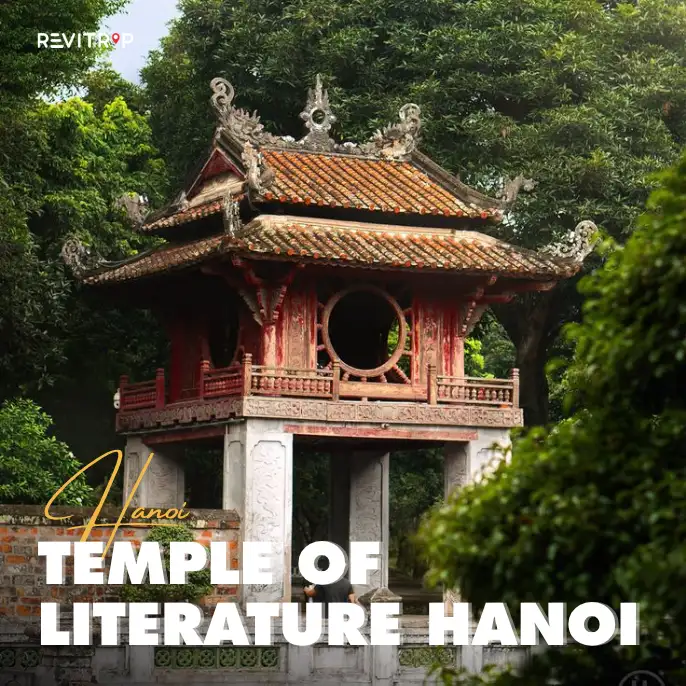
The first courtyard runs from the main entrance gate to the Great Middle Gate. It contains a tree-lined pathway and open garden space that sets the tone for the complex. The second courtyard centers on the Khue Van Cac, or Constellation of Literature Pavilion, one of the most photographed structures in Hanoi and an emblem of the city.
The third courtyard contains Thien Quang Tinh, the Well of Heavenly Clarity, flanked on both sides by the stone stele gardens. These 82 steles record the names, birth places, and academic achievements of 1,307 doctoral graduates between 1442 and 1779. They represent the most tangible record of Vietnamese intellectual history in existence.
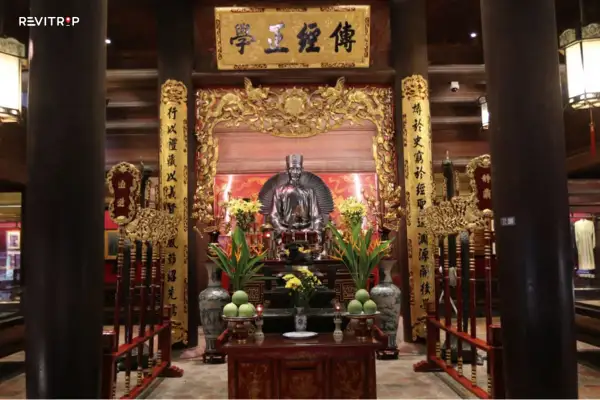
The fourth courtyard holds the main sanctuary, Dai Thanh, where Confucius and his four principal disciples are honored. The fifth and final courtyard contains the former site of the Quoc Tu Giam school itself, now a cultural exhibition space.
The Stone Steles
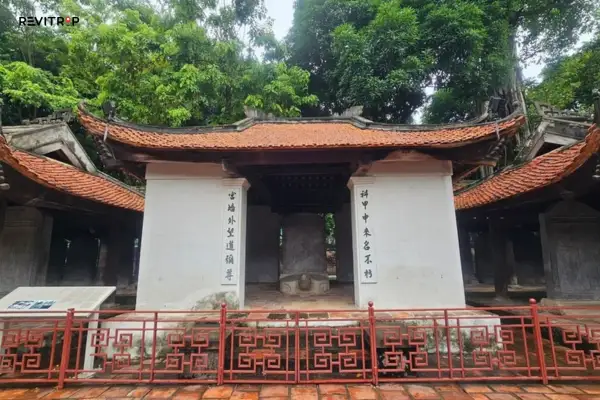
The doctoral steles of the Temple of Literature carry UNESCO recognition as part of the Memory of the World program. Each stele sits on the back of a stone tortoise, a traditional symbol of longevity and wisdom. Reading through the inscriptions gives a direct connection to the scholars who shaped Vietnamese governance, literature, and philosophy across four centuries.
“The stone steles at the Temple of Literature are not decorative. Each one is a record of a life committed to learning. Standing among them, you feel the weight of what scholarship has meant to this country across a thousand years.”
3. Practical Tips for Visiting the Temple of Literature
A few simple habits improve the visit significantly.
Before you go:
- Arrive early. The site opens at 8:00 am and the first hour is significantly quieter than midday.
- Dress modestly. Shoulders and knees should be covered as a mark of respect within the complex.
- Purchase the audio guide at the entrance if you want deeper historical context for each courtyard.
- Book a guided Hanoi cultural tour that includes the Temple of Literature through GetYourGuide for a structured experience with local commentary.
During your visit:
- Allow at least 90 minutes to move through all five courtyards without rushing.
- Read the information boards at each stele garden. The doctoral records are the historical core of the site.
- The Khue Van Cac pavilion in the second courtyard photographs best in morning light from the east-facing angle.
- Carry a bottle of water. The courtyards offer limited shade during midday in summer months.
For activity and experience bookings in Hanoi that pair well with a Temple of Literature visit, Klook lists a range of city tours and cultural experiences across the capital.
4. Combining the Temple of Literature with Other Hanoi Attractions
The Temple of Literature sits within easy distance of several other major Hanoi landmarks. Combining two or three sites in a single day is straightforward on foot, by bicycle, or by ride-hailing app.
Nearby attractions worth pairing:
- Hoa Lo Prison: approximately 15 minutes by motorbike or taxi, covers a very different but equally significant chapter of Hanoi history
- Ho Chi Minh Mausoleum complex: approximately 10 minutes by taxi, includes the One Pillar Pagoda and Ho Chi Minh Museum
- Vietnam Museum of Ethnology: approximately 20 minutes by taxi, covers the cultural traditions of all 54 ethnic groups recognized in Vietnam
- Hanoi Old Quarter: approximately 20 minutes by taxi or 30 minutes by bicycle, suits an afternoon of street food and market exploration
For a full overview of what to see and do across the capital, our Hanoi travel guide covers the city’s top attractions, best neighborhoods, and practical visitor tips in one place. If you are also planning to eat well during your Hanoi visit, our guide to street food in Hanoi covers the top dishes and where to find them near the major sightseeing areas.
Before your broader Vietnam trip, confirm your entry requirements through our Vietnam visa guide and review our scams in Vietnam article for practical safety awareness across the country.
“The Temple of Literature pairs naturally with the Ho Chi Minh Mausoleum complex. Together, the two sites cover the ancient and the modern chapters of Vietnamese identity in a single half-day circuit on the western side of the city.”
Final Thoughts: The Temple of Literature Belongs on Every Hanoi Itinerary
The Temple of Literature is one of those sites that earns its reputation without any marketing. Nearly a thousand years of history, 82 stone steles, five distinct courtyards, and architecture that has survived war, colonial occupation, and the passage of time all converge in a single city block in central Hanoi. It is not a reconstructed heritage attraction. It is the original.
Plan at least 90 minutes for the visit and arrive before 10:00 am for the quietest experience. Combine it with the Ho Chi Minh Mausoleum complex or Hoa Lo Prison for a full morning of historical depth. Then follow it with lunch at a street food stall in the surrounding neighborhood before continuing into the afternoon. For guided tours of Hanoi that include the Temple of Literature alongside the city’s other major cultural sites, explore available options through GetYourGuide and build your Hanoi day around a structure that makes sense.
FAQs
The Temple of Literature is a historic complex built in 1070 that served as Vietnam’s first national university. It honors Confucius and three Vietnamese kings, and contains 82 stone steles recording the names of doctoral graduates across four centuries. It is a National Historical Relic and one of Hanoi’s most visited cultural landmarks.
Adult tickets cost 70,000 VND. Vietnamese students and seniors pay 35,000 VND with valid ID. Children under 16 enter free. An audio guide in foreign languages costs an additional 100,000 VND. The site opens daily from 8:00 am to 5:00 pm.
Allow at least 90 minutes to move through all five courtyards comfortably. Visitors with a strong interest in Vietnamese history may want two hours to read the stele inscriptions and explore the exhibition spaces in the fifth courtyard. Arriving before 10:00 am gives you the quietest conditions.