
Most visitors to Ha Long Bay experience the landscape from the water. However, Bai Tho Mountain offers something genuinely different: a bird’s-eye view of the entire bay from the heart of Ha Long City itself. Also known as Poem Mountain, this 200-meter limestone peak rises dramatically from the urban center and rewards a 30-minute climb with one of the most spectacular panoramas in northern Vietnam. If you are spending time in Ha Long City before or after a bay cruise, this hike deserves a place on your itinerary.
Overview
| Detail | Information |
|---|---|
| Local Name | Nui Bai Tho (Poem Mountain) |
| Height | Approximately 200 meters above sea level |
| Location | Ha Long City center, near Hang Noi Street |
| Entrance Fee | 10,000 VND per person |
| Climb Duration | 30 to 50 minutes to the summit |
| Best Time to Visit | Early morning (06:00 to 08:00) or late afternoon |
| Difficulty | Moderate, with steep sections near the top |
| Nearest Landmark | Nam Phong Cafe, Hang Noi Street |
The History and Cultural Significance
Bai Tho Mountain is not simply a viewpoint. It carries centuries of Vietnamese cultural and historical significance. During his visit in 1468, King Le Thanh Tong paused at the mountain and, captivated by its beauty, carved a poem directly into one of the cliffside stones. This act gave the mountain its name. Subsequent dynasties followed the tradition, and today several poems and inscriptions carved into the rock face still remain, marking the mountain as one of Vietnam’s most unusual open-air literary monuments.

Bai Tho Mountain is a place that has gone down in history, connected with the poem of King Le Thanh Tong and other rulers inspired by the charming beauty of the bay. Beyond its poetic legacy, the mountain played a role in Vietnam’s resistance against foreign invaders across the centuries. At the summit, a stone stele marks Vietnam’s historical struggles for independence, and the national flag flies at the peak as a symbol of that heritage.
People have long interpreted the mountain’s shapes to look like a lying tiger, a preying lion, or a dragon preparing to fly. Half of its foothills extend over land, and the other half extend into the ocean. This dual character, part urban landmark and part bay landmark, is central to why Bai Tho Mountain feels so different from the bay’s other attractions. For broader context on Ha Long’s history and landscape, our Ha Long destination guide covers the full picture.
What to Expect on the Climb
Bai Tho Mountain does not have an official, maintained public hiking trail. In recent years, access has been restricted at times due to safety concerns, erosion, and the fact that the path passes close to residential areas. Consequently, the experience feels more adventurous than a standard tourist attraction. This is part of the appeal.
Finding the Entrance
The trailhead sits in a residential area near Hang Noi Street in Ha Long City center. Start by following the 18 Highway, crossing Bai Chay Bridge, then take the Dang Ba Hat – Ba Deo – Le Thanh Tong route. Continue along Le Thanh Tong Street to Hang Noi Street, where Nam Phong Cafe serves as a useful landmark. From there, ask a local resident for directions to the base.
There are two entrances in the area. One entrance sits next to a photocopy shop with a yellow sign and blue door. The other is near a motorbike store with a red-and-white sign reading “Cam Leo Nui.” Local residents near the base are generally helpful with directions. Some will offer informal guided access for a small additional fee, typically 50,000 to 100,000 VND on top of the official entrance charge.
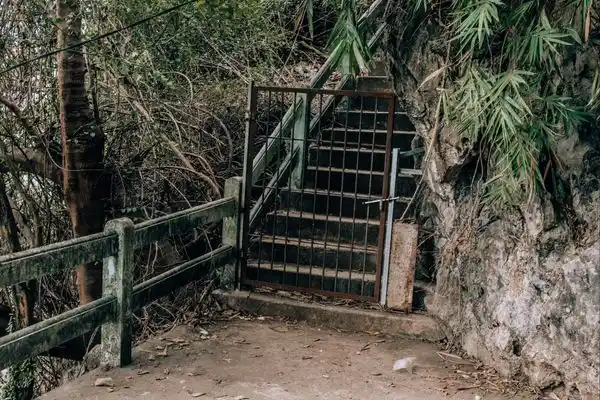
The Trail
Starting from the bottom, the climb takes around 20 minutes to reach the stairway, followed by another 30 minutes on a gravel trail to the summit. The lower section uses stone steps. The upper section transitions to an unpaved dirt and rock path that becomes noticeably steeper. Near the top, there is a silver ladder that leads to the upper rock face. It is not secured, so proceed carefully. Above the ladder, the final stretch involves scrambling over rocks while using tree roots and branches for support.
Along the way, cliffs hold hundreds of unnamed plants. At every step upward, you feel a cool breeze from the sea. Tree shade and birdsong accompany the climb, and goats occasionally graze on the slope sides. The physical demands are real. However, the trail suits reasonably fit travelers without any technical climbing experience.

I started the climb at 06:15 on a clear morning in late February. The sun was already up, and the lower staircase was shaded and cool. The upper scramble felt demanding but never genuinely dangerous. We reached the top in just under 50 minutes. The moment the view opens up at the summit is, without exaggeration, one of the best moments in Ha Long.
The Summit View
From the top, an expansive sky and the vast emerald sea stretch before you, with islands of all sizes and jagged rocks interspersed with cruise ships. You can see all corners of the city from up here, including the high buildings next to the contemplation church, the vast sea, slapping waves, the salty taste of the sea on the wind, and seagulls circling below.

This view is fundamentally different from anything you experience on the bay itself. From the water, you look up at the karsts. From Bai Tho Mountain, you look down across the entire system. The scale of the bay becomes immediately comprehensible. Many travelers name this viewpoint as the most memorable moment of their entire Ha Long trip. To plan what else to do during your stay, our Ha Long itinerary guide covers how to structure the full visit around this hike.
Best Time to Visit
Early morning is the strongest recommendation. Morning climbs offer the opportunity to witness a stunning sunrise over Ha Long Bay, while late afternoon hikes provide spectacular sunset views. Avoid the midday heat by climbing during these optimal times.
Timing your visit also connects to the broader Ha Long season. Spring (March to April) and autumn (September to November) offer the clearest skies and most comfortable temperatures for the climb. Our best time to visit Ha Long Bay guide covers the full seasonal breakdown to help you plan.
Avoid the trail after heavy rain. Some sections are unpaved and muddy, making them genuinely dangerous in wet conditions. Summer months bring frequent afternoon thunderstorms. Therefore, checking the daily forecast before heading out is essential between June and September.
Practical Tips
Wear the right footwear. Sports shoes with grip are the minimum requirement. Avoid sandals or flat-soled shoes on the upper rock section.
Start early. Aim for 06:00 to 07:00 to catch the best light and avoid the midday heat. Early starts also mean fewer people at the summit.
Bring water and snacks. There are no vendors on the mountain. Carry enough water for the full round trip, which typically takes 60 to 90 minutes in total.
Go in a group. The best approach is to ask your hotel staff or a local guide on the day itself. Climbing with at least one other person is strongly recommended, particularly on the upper rock sections where the path is least defined.
Check access conditions. Because the trail passes through a residential area and has faced periodic closure, confirming access on arrival day with your hotel is sensible. Conditions change and what was open last month may be temporarily restricted.
Know your physical limits. Individuals with heart conditions, hypertension, or those who are pregnant should refrain from the climb. The lower staircase section is accessible to most fitness levels. The upper rock scramble, however, demands genuine physical effort.

How to Combine Bai Tho Mountain with a Ha Long Trip
Bai Tho Mountain works best as a standalone morning activity in Ha Long City, ideally on your arrival day or your final morning before heading back to Hanoi. The climb and descent take under two hours. That leaves plenty of time for an afternoon cruise departure or a leisurely meal in the city afterward.
For a day entirely on land, pair the hike with a visit to the Quang Ninh Museum, a walk along the Bai Chay waterfront, and dinner at one of the city’s seafood restaurants. Our guide to the top 5 restaurants in Ha Long Bay covers the best dining options near the city center.
For travelers combining Ha Long with Ninh Binh, Bai Tho Mountain makes a fitting end to the Ha Long leg of the journey. It gives you one final aerial perspective of the bay before heading south into Ninh Binh’s rice paddies and river caves.
FAQ
Yes, the mountain is currently open to visitors. However, access conditions have fluctuated in recent years due to safety concerns and trail erosion. Always confirm with your hotel on the morning of your planned visit, as conditions can change with little notice.
The lower section uses maintained stone steps and suits most fitness levels. The upper section involves a steep, unpaved trail with a metal ladder and a short rock scramble that requires hands and feet. Overall, the hike is moderately challenging. It is not a technical climb, but it does demand reasonable fitness and sturdy footwear.
Most climbers reach the summit in 30 to 50 minutes depending on fitness level and the time spent on the upper scramble. Add another 20 to 30 minutes for the descent. Budget 90 minutes for the full experience including time at the summit.