CURRENCY AND PAYMENTS
With its incredible mix of budget-friendly food, comfortable hotels, and unforgettable experiences, Vietnam consistently delivers outstanding value for travelers. Before your trip, take a little time to understand how money works here. Knowing the local currency and payment landscape will save you stress and help you make the most of every day. Here is a practical guide to handling money in Vietnam.
Vietnamese currency
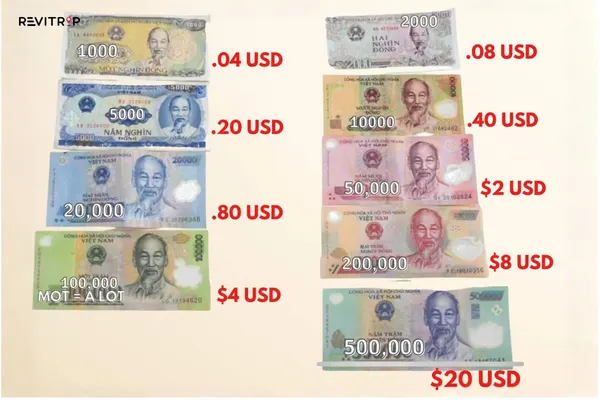
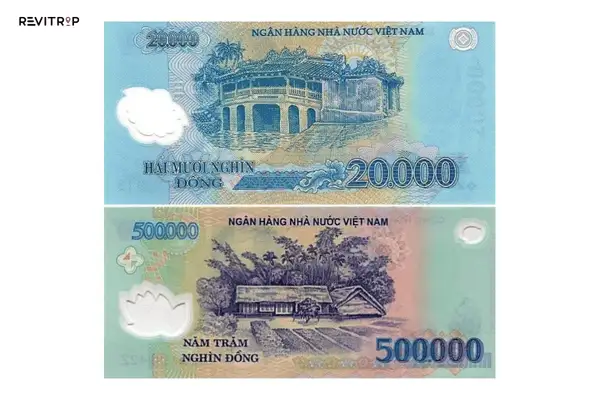
The official currency of Vietnam is the Vietnamese dong, written as ₫ or VND. Notes come as small paper bills and larger polymer bills, ranging in value from 10,000 VND to 500,000 VND. No coins are in circulation. If the number of zeros feels overwhelming, drop three zeros to get a simpler figure. To convert VND to USD quickly, remove three zeros and divide by 25.
“TIP: The 20,000 VND note and the 500,000 VND note share a similar blue color. Always double-check the value before handing over cash.”
Cash withdrawal and exchange
Having local currency ready when you arrive makes everything easier. ATMs accepting international cards are available just outside the arrivals hall at every major airport in Vietnam. In cities and tourist destinations, ATMs are easy to find on most main streets. Visa and other international cards work at more than 20,000 ATMs across the country. If you cannot locate one, your hotel front desk can usually point you to the nearest machine. Withdrawal limits vary: local bank ATMs typically allow between 2 million and 3 million VND per transaction, while international bank ATMs often allow between 5 million and 10 million VND.
Currency exchange counters operate inside international airports before the exit gates. Once you reach your destination, hotels, local banks, and exchange booths in tourist areas all offer exchange services.
“TIP: Withdraw extra cash before heading into rural or remote areas. Many local artisans and village vendors only accept cash, and ATMs can be hard to find outside main towns.”
Card payments in Vietnam
Cash remains the preferred option for street food, local markets, and small vendors. However, most established businesses accept major international credit and debit cards including Visa. Restaurants, hotels, tour operators, spas, boutiques, and grocery stores routinely process card payments. Your card provider sets the conversion rate and any applicable transaction fees. For larger travel expenses including accommodation and tours, card payment is generally straightforward and reduces the need to carry significant amounts of cash.
Local prices
Planning your daily budget is easier with a realistic sense of local costs. Vietnam accommodates every spending level, from backpackers eating at street stalls to travelers enjoying five-star hospitality. The price list below gives a practical reference point:
- Luxury hotel: 3,500,000 VND (140 USD) per night
- Sidewalk coffee: 25,000 VND (1 USD)
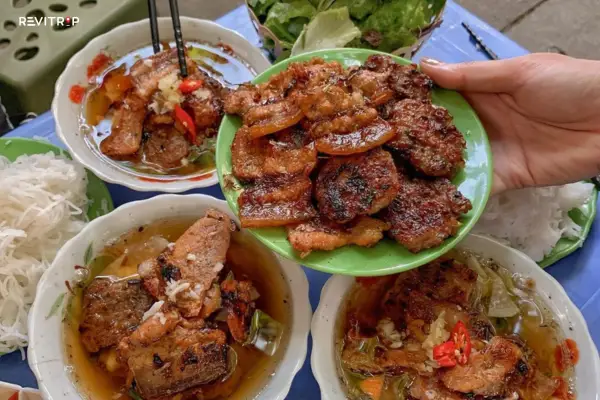
- Street food meal with iced tea: 50,000 VND (2 USD)
- Cappuccino at a cafe: 60,000 VND (2.50 USD)
- Three-course restaurant meal: 500,000 VND (20 USD) per person
- Inner city taxi: 40,000 to 100,000 VND (1.50 to 4 USD)
- 60-minute foot massage at a local spa: 350,000 VND (14 USD)
- Budget hostel: 300,000 VND (12 USD) per night
- Mid-range hotel: 750,000 VND (30 USD) per night
- Half-day group tour: 1,000,000 VND (40 USD)
Tipping etiquette
Tipping is not a traditional practice in Vietnamese culture and carries no fixed expectations. That said, it has become more common in certain situations. Private tour guides, spa staff, and hotel porters often appreciate a small tip for good service. In restaurants and cafes, tipping is not required but is always warmly received. A helpful frame of reference: a full local meal typically costs between 30,000 and 50,000 VND, which gives you a sense of what an extra gesture means in context.
Bargaining is common and accepted in markets and casual shopping areas, particularly in places that attract tourists. Ask around at a few different stalls before committing to a price, and approach negotiation with a friendly, relaxed attitude. A genuine smile and a reasonable counter-offer go further than hard bargaining in most situations.
Safety and security
Vietnam is a safe destination for the vast majority of travelers. That said, basic precautions go a long way. Store cash, cards, and valuables in your hotel room safe when going out. Keep your wallet or purse close to your body and stay alert in crowded spaces such as markets and busy transport hubs. Cards with built-in security features, including Visa’s 3D Secure system, offer additional protection against loss or fraud and reduce the stress of managing money on the road.
“TIP: Visa contactless payment is now accepted at a growing number of restaurants, shops, and taxi services across Vietnam. Tapping your card at a terminal is fast, secure, and means your card never needs to leave your hand.”