Most visitors discover Bich Dong Pagoda by accident. They come to Ninh Binh for the boat tours at Tam Coc or the UNESCO caves at Trang An, then someone mentions a pagoda a few kilometers down the road. They ride over on a bicycle expecting a quick stop and end up spending an hour climbing through cave temples carved into a limestone mountain, looking out over rice fields from the top of Ngu Nhac Mountain, wondering how they almost skipped this.
That is the quiet power of Bich Dong Pagoda Ninh Binh. It does not announce itself loudly. It rewards the visitors who find it.
What Is Bich Dong Pagoda?
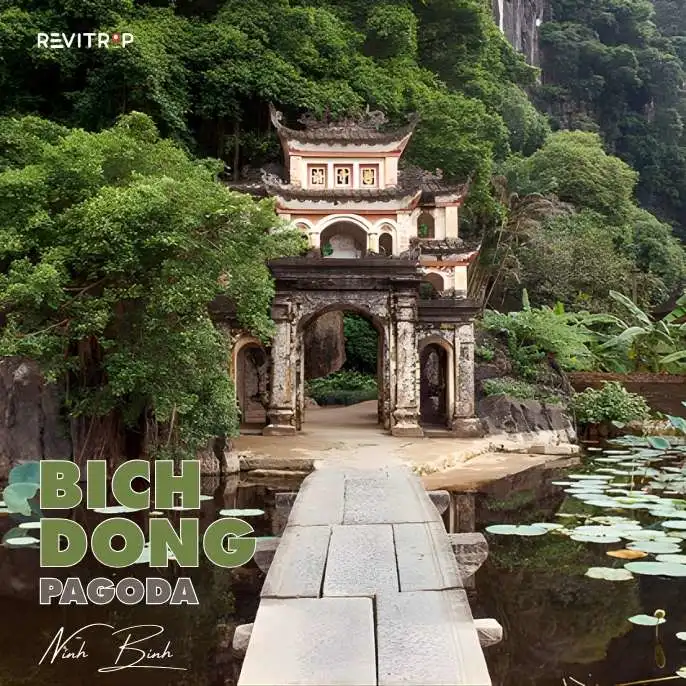
Bich Dong Pagoda is a 600-year-old Buddhist temple complex built directly into the face of Ngu Nhac Mountain in the Tam Coc area of Ninh Binh Province. Unlike flat, open temple complexes, Bich Dong climbs the mountain in three distinct levels, each revealing its own shrine, architecture, and cave passage. The approach crosses a stone bridge over a lotus pond, passes through a tropical garden corridor, and ascends through natural limestone caves and carved stone steps to a summit viewpoint that looks out over some of the most recognizable karst scenery in northern Vietnam.
Vietnamese scholars historically referred to it as “Nam Thien De Nhi Dong,” meaning the second most beautiful cave under Vietnam’s sky, after Son Doong in Phong Nha. Today, Bich Dong Pagoda sits within the Trang An Scenic Landscape Complex, the UNESCO World Heritage Site that covers this entire stretch of Ninh Binh Province.
The History of Bich Dong Pagoda
The pagoda’s story spans three distinct eras.
The original structure appeared in 1428, during the reign of Emperor Ly Thai To, as a small, modest temple on the mountain. For centuries it remained relatively unknown, half-hidden by vegetation, its potential unrealized.
In 1705, two Buddhist monks named Tri Kien and Tri The, traveling from Nghia Hung district in what is now Nam Dinh Province, discovered the site. Struck by the extraordinary natural setting, they restored the existing structure and expanded it into the three-tiered complex that stands today: the Lower Pagoda (Ha Pagoda), the Middle Pagoda (Trung Pagoda), and the Upper Pagoda (Thuong Pagoda). Local residents contributed donations to fund the reconstruction, embedding the pagoda into the spiritual life of the community from the beginning.
The third and final chapter came in 1774, when Lord Trinh Sam of Dang Ngoai visited the complex and renamed it “Bich Dong,” meaning “The Emerald Pagoda” or “Green Pearl Cave,” inspired by the jade-green color of the surrounding mountains and forest. That name has held for over 250 years.
The Three Levels of Bich Dong Pagoda
The Entrance and Ha Pagoda (Lower Pagoda)
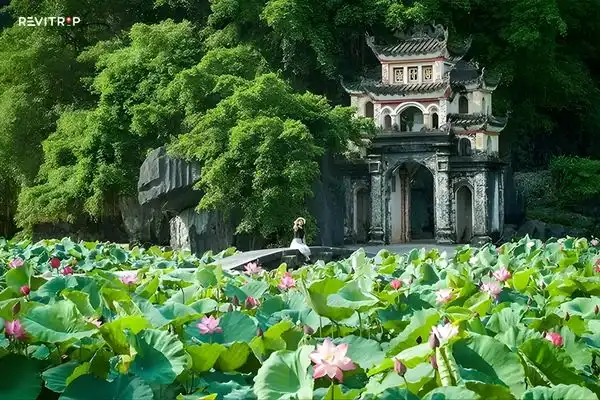
The first thing that strikes visitors at Bich Dong is the entrance. A narrow stone bridge stretches across a lotus pond, flanked by water and framed by a carved archway. In the right season, the lotus blooms turn the approach into one of the most photogenic spots in Ninh Binh. On the far side of the bridge, a corridor of tropical garden opens up, with wet limestone on one side and a carved stone wall on the other.
Ha Pagoda sits at the foot of the mountain, quiet and shaded. The layout follows the traditional Vietnamese “Dinh” floor pattern, with a front courtyard and multiple shrine rooms. Ancient statues, stone steps, and a thick canopy of frangipani trees give this level a contemplative atmosphere. This is where many visitors slow down and feel the shift from tourist site to genuinely sacred space.
Trung Pagoda (Middle Pagoda) and the Dark Cave
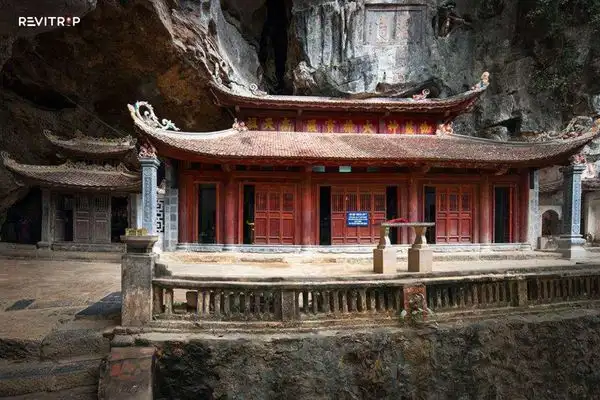
From Ha Pagoda, around 120 stone steps carved into the rock face lead up to Trung Pagoda, set halfway up the mountain and built directly against the limestone cliff. The ceiling above the main shrine is the living rock of the cave dome. Traditional tiled roofs blend with cliff faces, carved stone ornamentation depicts dragons, turtles, fairies, and Buddha figures, and a massive 18th-century bronze bell hangs in the deeper cave passage.
On the left side of Trung Pagoda, a narrow passage leads into Hang Toi, the Dark Cave. Twenty-one steps descend into the grotto, which is famous for the limestone stalactites covering its ceiling in fantastical shapes. The cave serves as a place of worship for both Buddha and Mau Thuong Ngan, the Mother forest goddess of Vietnamese folk religion. The large bronze bell here is said to relieve the pain of injustice when rung three times.
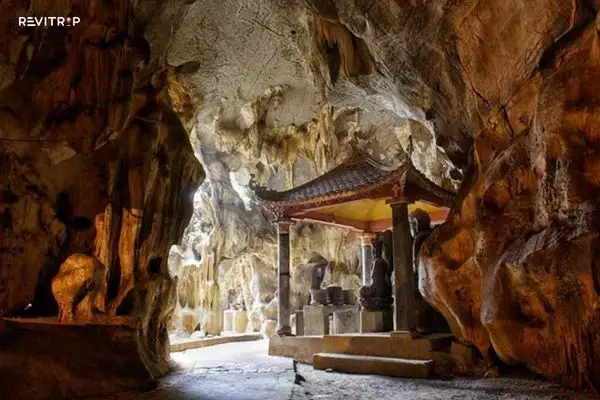
A practical note: in wet weather the entrance to Hang Toi becomes extremely slippery, and the cave itself can flood. The monks close it to visitors under those conditions. Check conditions before committing to the climb in rainy weather.
Thuong Pagoda (Upper Pagoda) and the Summit View
Forty steep stone steps beyond the Dark Cave lead to Thuong Pagoda, the highest point of the complex and the reward for everyone who makes the full climb. The upper pagoda holds two rooms: an outer room with a forecourt and stone altar, and an inner room housing a statue of Bodhisattva Guanyin, also known as Quan The Am in Vietnamese. Two smaller shrines outside honor the god of the soil and the god of the mountain.
Beside the main structure sits the Cam Lo pond, a small water pool that local tradition holds can cure ailments. Large frangipani trees frame the pagoda on both sides, and in season their fragrant blossoms add a sensory layer to the view that no photograph can quite capture.
The panorama from Thuong Pagoda takes in the full sweep of the Tam Coc valley: rice fields stretching to the horizon, the Ngo Dong River winding through the flat farmland, and limestone peaks rising sharply from the plain on every side. Very few tourists make it all the way to the top. Those who do consistently say it is the best view of the Tam Coc landscape they found during their entire time in Ninh Binh.
Practical Information
| Detail | Info |
|---|---|
| Location | Ngu Nhac Mountain, Ninh Hai Commune, Hoa Lu District, Ninh Binh |
| Opening hours | 7:30 AM – 4:30 PM daily |
| Entrance fee | Free (small donation welcome; ~10,000-20,000 VND parking fee) |
| Time needed | 1-1.5 hours for all three levels |
| Distance from Tam Coc Wharf | ~2-3 km (~10-15 min by bicycle) |
| Distance from Ninh Binh city | ~12 km (~20 min by motorbike) |
| Distance from Hanoi | ~110 km (~2-2.5 hours by car or limousine) |
| Dress code | Modest clothing required; cover shoulders and knees |
| Physical demand | Moderate: 120+ steps to Trung Pagoda, 40 more to Thuong Pagoda |
How to Get to Bich Dong Pagoda
The most popular approach is by bicycle from Tam Coc Wharf, a flat 10-15 minute ride along village roads through rice paddies and karst scenery.
- Bicycle rentals cost 50,000-80,000 VND per day at most hotels in the area.
- By motorbike the ride takes 5-7 minutes, with parking at the gate running 10,000-20,000 VND.
- From central Ninh Binh city, a Grab or taxi costs around 80,000-100,000 VND and takes roughly 20 minutes.
When to Visit Bich Dong Pagoda
Bich Dong rewards visitors year-round, but the experience shifts with the seasons. Spring (March to May) brings frangipani blooms around Thuong Pagoda and fresh green shoots in the rice fields below. Summer (May to August) is the hottest period: the caves offer welcome shade, but the climb to the upper pagoda is demanding in the heat. Autumn (September to November) delivers the golden rice harvest season, when the valley view from the summit turns amber and yellow. Winter (December to February) is the quietest period, with fewer visitors and a more contemplative atmosphere despite the bare lotus pond at the entrance.
The best overall windows are April to June and October to December, balancing comfortable temperatures with scenic conditions. Whatever season you choose, arriving before 9:00 AM or after 3:00 PM keeps the crowds manageable.
Bich Dong Pagoda in Your Ninh Binh Itinerary
Bich Dong Pagoda sits naturally alongside Tam Coc in any single-day Ninh Binh plan. The most common combination runs like this: arrive at Tam Coc early for the boat tour, then cycle to Bich Dong immediately afterward while the morning is still cool. The total time for both is around 4-5 hours, leaving the afternoon free.
For a longer day that covers the full historical and natural scope of the region, add Hoa Lu Ancient Capital in the morning before Tam Coc. Hoa Lu, Tam Coc, and Bich Dong form one of the most complete single-day itineraries in Ninh Binh, covering an imperial capital, a UNESCO boat tour, and a centuries-old cave pagoda in one loop.
If you are deciding between Trang An vs Tam Coc as your main boat experience, know that only the Tam Coc itinerary puts Bich Dong within easy cycling distance. Adding Trang An to the same day is possible but requires a car or motorbike rather than a bicycle.
Honest Tips Before You Visit
Go early or late. Bich Dong is peaceful before 9:00 AM and after 3:00 PM. Midday on weekends brings the biggest crowds at the bridge and Ha Pagoda level.
Wear proper shoes. The stone steps are uneven and become slippery after rain. Sandals with no grip make the climb harder than it needs to be.
Do not skip the summit. Many visitors turn back at Trung Pagoda. The climb to Thuong Pagoda takes five more minutes from the Dark Cave exit, and the view at the top is the reason to visit.
Dress modestly. Bich Dong is an active place of worship. Cover shoulders and knees before entering the temple areas.
Entry is free. Some sources quote fees for the wider Tam Coc-Bich Dong complex, but the pagoda itself costs nothing. A parking fee of 10,000-20,000 VND applies at the gate.
Where to Stay Near Bich Dong Pagoda
Bich Dong Pagoda sits at the edge of the Tam Coc area, making the cluster of accommodation around Tam Coc Wharf the most convenient base.
Tam Coc Garden Resort offers Tonkinese-style villas, a private onsen chamber, and a garden-to-table restaurant within a short ride of the pagoda.
For a more practical four-star option with rice field views and walking distance to the boat tours, Ninh Binh Hidden Charm Hotel & Resort puts both Tam Coc and Bich Dong within easy reach.
FAQ:
Without question. The combination of a lotus pond entrance, cave shrines built into living rock, a Dark Cave with ancient stalactites and a bronze bell, and a summit view over one of Vietnam’s most distinctive landscapes makes Bich Dong one of the most layered experiences in Ninh Binh. The fact that it costs nothing to enter and takes only an hour to explore makes the calculus easy.
As with many Buddhist sites, Bich Dong Pagoda has a dress code that requires visitors to cover up their shoulders and knees.
There’s no official entrance fee to visit Bich Dong Pagoda. It’s completely free. However, someone often charges a small parking fee (around 10,000 VND) if you leave your scooter or bicycle right by the entrance.