Hanoi’s Old Quarter can feel like a loop of narrow streets, scooters, and the same three souvenir items multiplied into infinity. You step in a souvenir store in Hanoi “just to look,” and suddenly you’re holding a lacquer bowl, two fridge magnets, and a scarf that might be silk or might be a confident piece of polyester with a good sales pitch.
If you’re a foreign traveler, the real problem is usually pricing gravity. In a busy tourist zone, prices float. They drift toward whatever you seem willing to pay in the moment. That’s how you end up spending premium money on something that was always meant to be cheap.
This is not a “best shops” list. It’s a selection system, so you can walk into any souvenir store in Hanoi’s Old Quarter, read it fast, and leave with a fair price and zero buyer’s remorse.
Quick Answer
To avoid tourist-priced shopping in Hanoi’s Old Quarter, do this:
- Walk 3–8 minutes away from Hoàn Kiếm Lake before you buy anything bigger than a magnet. Convenience zones tend to inflate prices.
- Prefer shops with visible price tags (or clear ranges). Transparent pricing is usually calmer pricing.
- Do a 60-second quality scan: check edges, stitching, cracks, and then step into daylight for color truth.
- Negotiate hardest on duplicated items you see in multiple shops. If it’s everywhere, it’s not rare.
That’s the whole trick. In the Old Quarter, the win isn’t finding the one magical shop – just walking in with a simple way to read the room, so the price stops being a surprise.
What to See in Hanoi Old Quarter: 15 Must-Visit Spots
Why “tourist-priced” happens here (and why it’s not personal)
Old Quarter pricing is flexible because the Old Quarter is built for speed. People buy while walking. Many customers are one-time encounters. That pushes sellers toward a “start high, adjust based on response” approach.
Add heat, noise, decision fatigue, and the fact that you don’t have local reference prices yet, and you get the classic pattern: you pay extra not because you’re careless, but because the environment is designed to make “just end this transaction” feel like relief.
This doesn’t mean you should become suspicious of everyone. You should become methodical instead. So don’t moralize it. Don’t get angry at yourself. Just shop like someone who understands the game exists.
The 60-second store read: how to tell what kind of souvenir store you’re in
Before you touch anything, scan the shop the way you’d scan a restaurant menu. Most souvenir stores in the Old Quarter fall into two categories: fast souvenir churn or curated retail. Both can be fine; they just deserve different expectations.
Here are three fast tells:
- Price visibility: tags, ranges, or a consistent pricing system signals fewer “special price for you” moments.
- Product repetition: if the shop looks like it’s selling the same inventory as five nearby stores, it’s a negotiation-friendly zone.
- Display discipline: curated shops tend to group items cleanly and carry fewer “filler” products. Chaos usually means quantity over quality.
None of these proves anything alone. They just help you decide whether you’re in “buy small + bargain” mode or “buy fewer + pay fair” mode.
The one question that cuts through the “handmade” fog
Avoid yes-questions. “Is this handmade?” will always be “yes,” delivered with a smile that suggests you should stop asking questions.
Instead, ask something that forces specificity:
“Made where?” or “What material is this, exactly?”
You’re listening for details: a named village, a workshop story, a material description that sounds like someone has actually held the raw inputs before. If the answer is vague – “good quality,” “from a village,” “real silk” – assume it’s mass-made or mixed, and price it like that.
The point isn’t to interrogate people. It’s to keep your wallet from paying “craft story pricing” for factory goods.
The finish test: how to spot quality without being an expert
This is the part that stops regret.
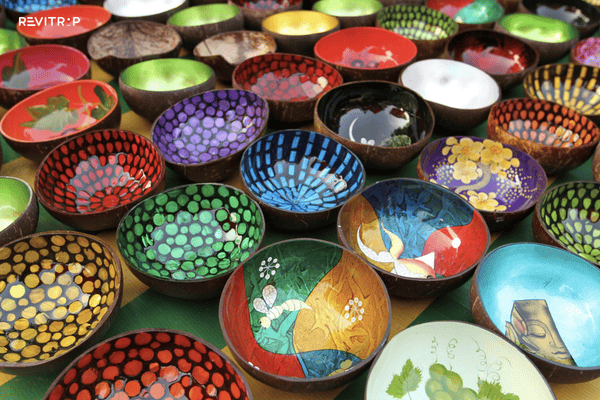
- Lacquerware: check corners and edges for micro-chips or bubbles under the surface. Cheap lacquer looks glossy but fails at the edges first.
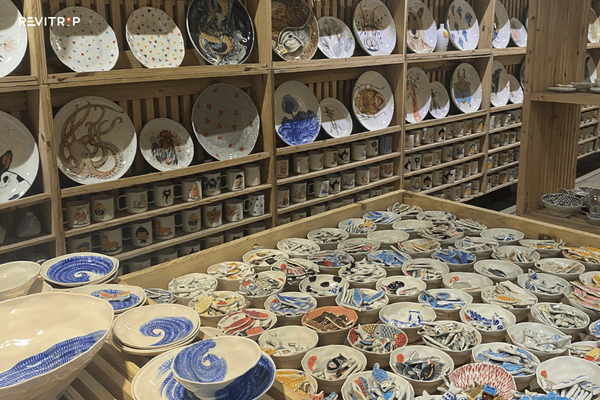
- Ceramics: run your finger under the base. Rough, gritty bottoms = poor finishing and higher risk of cracks.
- Bags/wallets: check stitching density and tension. Loose stitches are future tears.
- Scarves: texture tells the truth faster than labels. If it feels slick and plasticky, treat it as synthetic.
Then step one step outside into daylight. Warm shop lighting is a flattering liar.
The simplest pricing rule in Hanoi: “If it’s everywhere, it’s negotiable”
Here’s a rule that travels well:
If you see the same item repeated across multiple souvenir stores within a short walk, you’re not dealing with rarity. You’re dealing with distribution.
That’s when you negotiate – lightly, politely, without turning it into drama. The cleanest move is bundling: buy two or three small items and ask for the best price. You’ll often get a better number without having to perform.
On the other hand, if something is clearly better finished: sharper edges, more interesting glaze, cleaner stitching, don’t squeeze it until it stops making sense. Paying fair for real workmanship is part of not buying junk in the first place.
Red flags that you’re about to get tourist-priced
Not every red flag means you’re being scammed. But these are the patterns that usually lead to inflated prices or annoying surprises:
- No price tag, then instantly: “special price for you”
- Vague origin story that never gets more specific than “local” or “from village”
- Pressure tactics like “only today,” “last one,” or emotional guilt
- You’re shown one item, but a slightly different one gets bagged
- Bundle math done too fast, without showing the breakdown
If two or three of these show up at once, step out. Walking is the most effective negotiation tool in the Old Quarter.
Dong Xuan – Hanoi Night Market: Charm of the Old Quarter
What I’d actually buy from an Old Quarter souvenir store
If you want souvenirs that pack well, feel like Hanoi, and don’t turn into clutter, keep it simple:
- A small lacquer dish or tray (functional, durable, visually Vietnamese without being loud)
- One or two ceramic pieces you genuinely like (don’t build a fragile suitcase museum)
- A print on decent paper (roll it; don’t fold it; your future self will thank you)
Everything else is optional. Magnets and postcards are fine as “quick gifts.” Just price them as small fun, not as artisanal treasures.
Bottom line
Picking a souvenir store in Hanoi is about controlling variables: location (walk a little), transparency (price tags), quality (finish test), and leverage (same-item rule).
Do that, and you’ll buy souvenirs the way you want to travel: practical, calm, and annoyingly efficient, so your memories don’t come with a side of regret.
FAQ
A good Hanoi souvenir is something that’s small, durable, and actually usable. In the Old Quarter, the safest bets are a small lacquer dish/tray, one ceramic cup/bowl you genuinely like, or a quality print/postcard set you can frame later. They pack well, they still feel “Hanoi” months later, and they don’t rely on a complicated origin story to be worth it.
For cheap souvenirs, stay in the Old Quarter but keep it practical: shops right around Hoan Kiem Lake and the night market area are best for low-stakes items like magnets, keychains, postcards, and tote bags.
If you’re traveling across Vietnam, think in categories that survive transport and still feel local: lacquerware, ceramics, Vietnamese coffee (beans or drip phin), non-fragile textiles, and small food gifts (sealed, packaged items like candies or dried snacks).