Hanoi will feed you whether you’re ready or not. You can wander into the Old Quarter half-lost, point at something steaming, and still walk away thinking, “Okay, this city has range.” The problem isn’t finding food. The problem is decision fatigue: cuisine in Hanoi comes with a menu written in shorthand you don’t speak yet, the table next to you is eating something better, and you have exactly one battery bar left for logistics.
Most guides solve this by dumping a checklist on your lap. That’s how you end up ricocheting between “must-tries” and accidentally ordering the same dish family three times in a row. A cleaner approach is to decode the menu words that show up everywhere. Once you understand the small vocabulary cuisine in Hanoi uses to label its bowls and plates, you stop guessing – and the city stops feeling like a test.
My simple rule
Order Hanoi cuisine in three steps: pick the noodle base (bun/pho/mien), choose the format (nuoc/tron), then choose the protein (cha/thit/bo/ga).
Do that and you can walk into almost any casual spot and land a solid bowl on the first try.
Step 1: Pick your lane – bún, phở, miến, mì
If you only learn four words for cuisine in Hanoi, learn these. They’re less “dish names” than categories – the skeleton underneath a hundred variations.
Bún
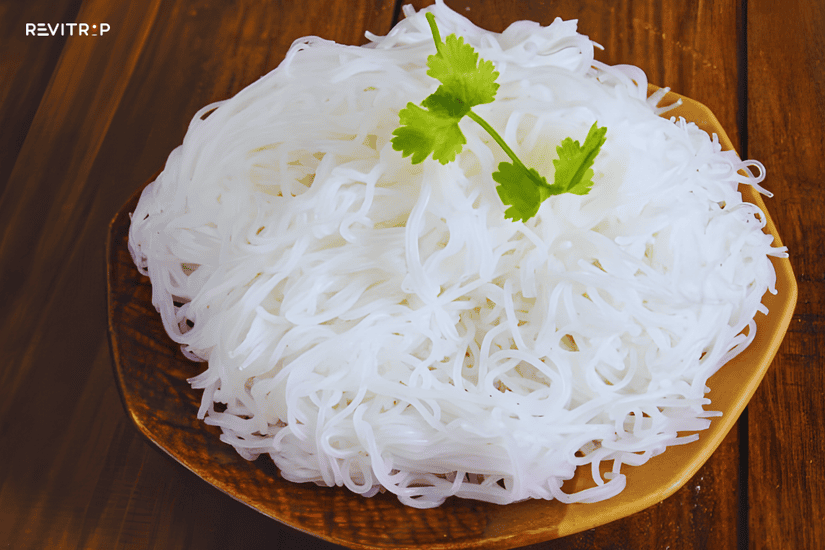
Bún is rice vermicelli: light, springy strands that play well with grilled meat, fresh herbs, and dipping sauces. In Hanoi, bún is the backbone of warm-weather eating. It feels clean, aromatic, and refreshingly unfussy. If you’re sweating through your shirt by 10 a.m., bún is often the smartest first move.
Phở
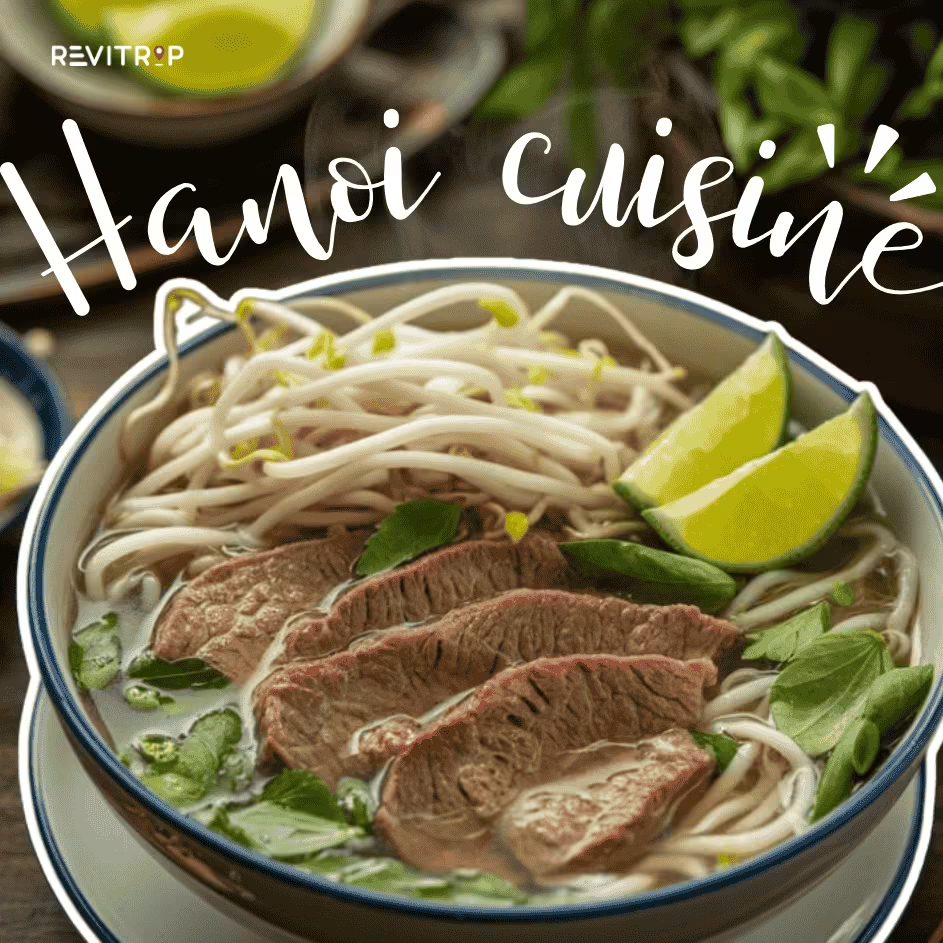
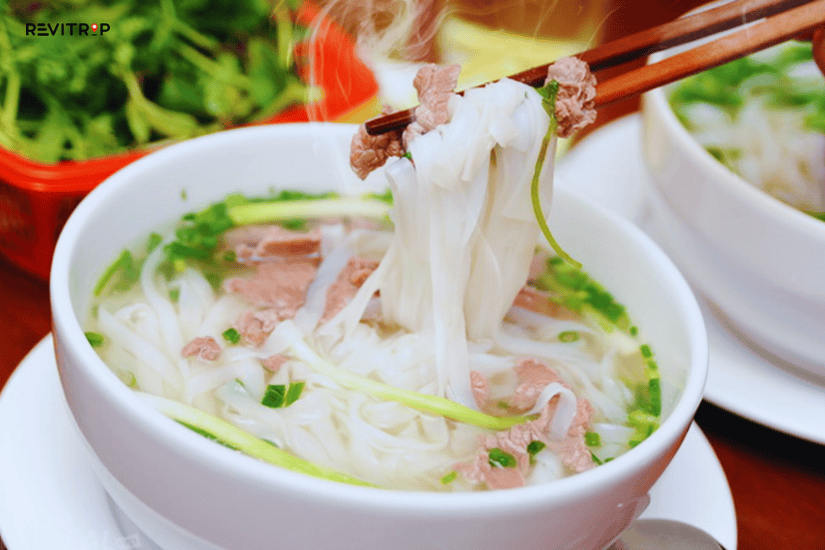
Phở is broader rice noodle in broth – the most internationally famous, and still worth doing properly in its hometown. Hanoi phở tends to be more restrained than southern styles: clearer broth, less sweetness, more quiet confidence. If your goal is comfort that doesn’t knock you out, phở is the classic.
Read more: Pho Noodles: The History of Vietnam’s Most Famous Dish
Miến
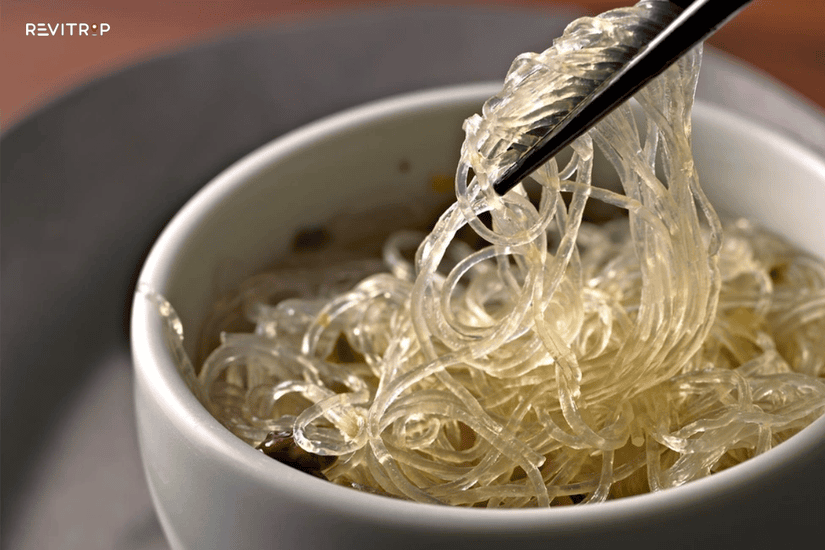
Miến is glass noodle (often mung bean-based). It’s slippery, slightly chewy, and usually lighter on the stomach than you expect. If you want “noodles in soup” without the heaviness of a large wheat noodle bowl, miến is a good compromise. Miến dishes also show up a lot with chicken.
Mì
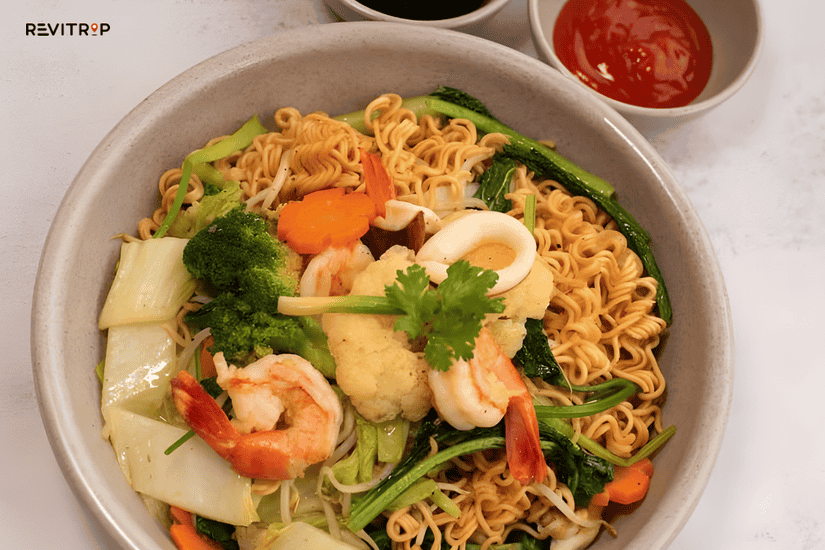
Mì is typically wheat or egg noodles. In Hanoi, mì can go brothy or dry, but it often reads a little richer and more “meal-like.” If you’re craving something with more bite and a more assertive chew, mì is your lane.
Practical shortcut:
- Want light + herb-forward? Start with bún.
- Want cozy + balanced? Start with phở.
- Want lighter soup or chicken-friendly? Try miến.
- Want chewy + rich? Go mì.
Step 2: Choose the format – nước vs trộn
This is the pivot most first-timers miss. Two bowls can share the same noodles and protein, but “nước” versus “trộn” changes the entire experience.
Nước
“Nước” signals liquid – usually soup broth, sometimes a more generous sauce situation. If you see bún nước, miến nước, or something similar, expect a bowl you eat with chopsticks and a spoon, built around heat and fragrance.
Trộn
“Trộn” means mixed. Not “salad,” not “cold,” not automatically dry – just mixed rather than swimming. In practice, trộn bowls tend to come with a dressing or sauce that coats instead of floods. They’re faster to eat, easier in hot weather, and often more intense in flavor because the sauce is concentrated.
When in doubt:
If you’re eating on the move, low patience, high hunger – trộn is the no-drama choice. If you want a slower meal that feels restorative – go nước.
Step 3: Decode proteins and toppings – chả, thịt, bò, gà, tôm
Once you’ve got noodles + format, protein words become surprisingly predictable.
- Thịt = meat (often pork unless specified)
- Bò = beef
- Gà = chicken
- Tôm = shrimp
- Trứng = egg
- Chả = a broad “prepared” category: patties, rolls, or slices (often pork-based), sometimes grilled, sometimes steamed, sometimes fried
Chả is the one word tourists treat like a mystery box. Think of it as Hanoi’s “processed with intention” protein family. If you like grilled, savory, slightly smoky things – chả is usually your friend.
Read more: Bun Cha Hanoi: Skip or Visit?
The cooking-method words that matter
These are the verbs that tell you what you’re about to get. They’re the difference between “why is this oily?” and “oh, that’s exactly what I ordered.”
- Nướng = grilled (often charcoal, especially in classic Hanoi spots)
- Chiên = fried
- Xào = stir-fried
- Luộc = boiled (often for chicken, greens, or simple sides)
- Hấp = steamed
If you’re trying to keep the day light and functional, prioritize nướng and luộc. If you’re treating dinner like a reward, chiên and xào are where the city starts flexing.
The “flavor toolkit” behind cuisine in Hanoi
Hanoi food isn’t loud for the sake of it. It’s calibrated. You’ll keep seeing the same flavor pieces recombined in different proportions.
- Nước mắm (fish sauce) – salty backbone, often softened with sugar, lime, and water
- Dấm (vinegar) – acidity without citrus sharpness
- Tỏi (garlic) and ớt (chili) – you control the intensity
- Rau thơm (herbs) – the freshness lever that makes bowls feel bright, not heavy
- Mắm tôm (fermented shrimp paste) – the polarizing one; powerful, funky, and very “Hanoi”
Safety-first rule that still respects the food:
If you’re unsure about your stomach, go easy on raw greens from random places, add chili slowly, and treat mắm tôm like a “try with a plan,” not an impulse.
Five safe first orders (when you’re hungry and tired)
These aren’t “best-of lists.” They’re reliable defaults – the kind of orders that work even when your brain is cooked from traffic and heat.
- Phở bò (beef phở)
A stable baseline. If you like it here, you’ll like it almost anywhere. - Miến gà (chicken glass noodle soup)
Light, soothing, and usually gentle on the stomach. - Bún with grilled pork (look for “nướng” or “chả”)
Herbs, smoke, sweet-salty dip – this is Hanoi at street-level.
Read more: Bun Cha Ha Noi: What It Is And Where to Eat It? - A trộn bowl with chicken or beef
Great when it’s hot and you want flavor without a hot broth commitment. - A simple fried or grilled side + noodles
If you see something that looks like a “set” meal, that’s often the easiest way to eat well without over-ordering.
Common tourist mistakes (and clean fixes)
Mistake 1: Ordering by vibes, not vocabulary
The photo looks good, you point, you hope. Sometimes it works. Often you get a bowl that’s fine but not what you wanted.
Fix: Ask or gesture for the two decision points: nước or trộn, and which protein word you see.
Mistake 2: Over-spicing too early
Hanoi sauces are modular. You’re meant to adjust, but tourists often go full send at the start, then spend the rest of the meal sweating and regretting.
Fix: Add chili in small increments. Taste first. Adjust after three bites, not one.
Mistake 3: Treating mắm tôm as mandatory
It’s iconic, but it’s not a rite of passage you need to force at the wrong moment.
Fix: Try it when you’re not already tired or dehydrated. Choose a place that looks busy with locals. If it’s your first time, ask for a smaller amount or dilute it with lime.
Mistake 4: Trying to “win” cuisine in Hanoi in one day
You can’t. And the attempt makes your day feel chaotic.
Fix: Build one loop, not a checklist. Choose one neighborhood, eat two proper meals, and protect one buffer (coffee, museum, lakeside walk). Your appetite – and your mood – will last longer.
FAQ
What is the most famous food in Hanoi?
Phở is the signature dish. If you want the most Hanoi-specific follow-up, make it bún chả.
What should I eat in Hanoi’s Old Quarter?
Do phở for breakfast and bún chả for lunch, then add bánh cuốn if you want a lighter third meal.
Where can I find Hanoi street food locations that are easy for first-timers?
The Old Quarter around Hoan Kiem is the simplest, most walkable option. For a calmer, more focused food strip, go to Ngũ Xã in the Trúc Bạch area.