Planning a trip to Vietnam? Understanding Vietnam currency before you land saves you time, confusion, and money. From street food stalls to five-star hotels, knowing how Vietnamese dongs work – and how to spend them smartly – makes every transaction straightforward. This is your complete Vietnam currency for tourists guide!
1. What Is the Official Vietnam Currency?
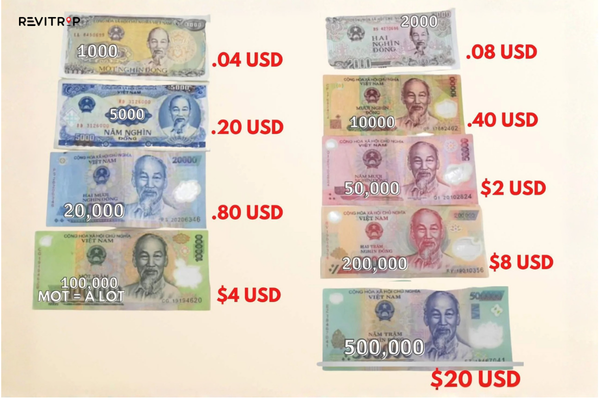
The official Vietnam currency is the Vietnamese đồng, written as ₫ or VND. The State Bank of Vietnam, acting as the country’s central bank, issues notes ranging from 10,000 VND to 500,000 VND. No coins circulate. Notes come as a mix of small paper bills and larger polymer bills.
All those zeros can feel daunting at first. Drop three zeros mentally to get a simpler number. To convert Vietnamese dongs to USD, drop three zeros then divide by 23.
📌 The 20,000 VND bill and the 500,000 VND bill share similar shades of blue — double-check before handing over cash.
2. Cash Withdrawal and Currency Exchange in Vietnam
Sorting cash on arrival is straightforward. ATMs accepting international cards sit just outside the arrival gates at all major airports. You will find ATMs throughout Vietnamese cities with little difficulty.
International cards such as Visa work at more than 20,000 ATMs nationwide. Withdrawal limits vary by ATM type:
- Local bank ATMs: 2 million VND to 3 million VND per transaction (roughly USD 80–130)
- International bank ATMs: 5 million VND to 10 million VND per transaction
Currency exchange counters are available inside international airports just before the exit gates. Hotels, tourist hotspots, and local banks also offer exchange services. Keep an eye on the current exchange rate before converting – rates vary across providers.
📌 Heading somewhere remote? Withdraw extra Vietnamese dongs beforehand, especially if you plan to buy crafts directly from local artisans.
3. Card Payments: How Cashless Is Vietnam?
Cash still dominates for small purchases and street vendors. However, Vietnam currency transactions via credit cards are widely accepted at most established businesses. Hotels, tour operators, boutiques, restaurants, grocery stores, and spas all take major international credit cards.
Your card provider sets the exchange rate and any applicable fees. Most larger travel expenses — booked on the spot or paid online in advance — go straight on card. This reduces the need to carry large amounts of cash throughout your trip.
📌 Many businesses and taxi services now accept Visa contactless payments. Tap your card on the terminal — it never leaves your hand.
4. Local Prices: How Far Does Vietnam Currency Go?
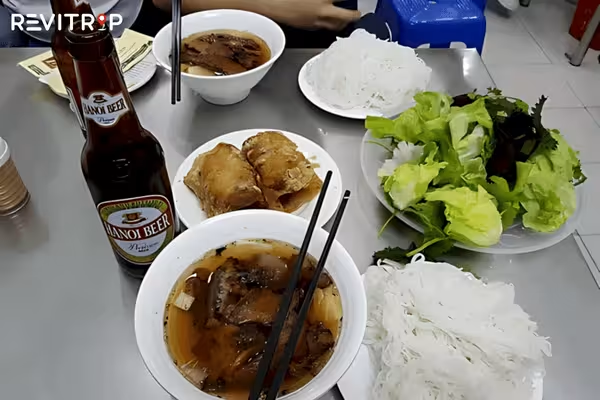
Vietnam currency stretches remarkably well – whether you travel on a tight budget or prefer five-star comfort. Here is a snapshot of average prices to help you plan:
- Sidewalk coffee — 25,000 VND (USD 1)-
- Street food meal with iced tea — 45,000 VND (USD 2)
- Cappuccino in a café — 55,000 VND (USD 2.50)
- Three-course restaurant meal — 450,000 VND (USD 20) per person
- Inner-city taxi ride — 35,000 to 100,000 VND (USD 1.50–4)
- 60-minute foot massage at a local spa — 350,000 VND (USD 15)
- Budget hostel — 300,000 VND (USD 13) per night
- Mid-range hotel — 700,000 VND (USD 30) per night
- Half-day group tour — 1,000,000 VND (USD 43)
- Luxury hotel — 3,500,000 VND (USD 150) per night
5. Keeping Your Vietnam Currency Safe While Traveling
Vietnam is safe for travelers, but a few practical habits make a real difference. Store cash, credit cards, and valuables in the hotel room safe before heading out. Keep your wallet close and stay alert in crowded areas.
Cards with built-in security features – such as Visa’s 3D security system – protect against loss and fraud. Contactless payments add another layer of security by keeping your card in your hand throughout the transaction.
6. Tipping and Bargaining: What You Should Know
Tipping is not a standard part of Vietnamese culture, but it is growing in certain settings. Beauty salons and private tour guides appreciate a tip. Restaurants and cafés do not expect one, though it is always welcome.
A useful reference: a typical local meal costs 30,000 to 40,000 VND. Use that to gauge a fair tip. In markets and tourist shopping areas, bargaining is normal — browse a few stalls, get a feel for the going rate, then negotiate with a relaxed attitude.
Final Thoughts: Get Comfortable with Vietnam Currency Before You Arrive
Mastering Vietnam currency is one of the best ways to travel smarter across this remarkable country. Monitor the exchange rate before departure, keep a mix of Vietnamese dongs and credit cards on hand, and remember that the State Bank of Vietnam – the nation’s central bank – regulates all currency in circulation. Whether you tap your card at a restaurant or bargain at a local market, Vietnam currency for tourists goes far. Plan ahead and let Vietnam’s outstanding value speak for itself!
The exchange rate fluctuates daily based on the State Bank of Vietnam’s regulations. As a quick reference, dividing the VND amount by 23,000 gives you a rough USD equivalent. Always check a reliable currency converter or your bank’s official rate before exchanging Vietnamese dongs to get the most accurate figure.
You can exchange Vietnamese dongs to USD at international airports, local banks, and hotel front desks across the country. For the best exchange rate, compare rates at a few providers before converting. Avoid exchanging money at unofficial vendors to protect yourself from fraud.
The Euro to VND exchange rate changes daily. As a general estimate, 1 EUR equals roughly 25,000 to 26,000 VND, though this varies depending on the provider and the State Bank of Vietnam’s daily reference rate. Use a trusted currency converter or check with your bank for the most up-to-date figure before your trip.